How to Manage Your Digital Assets Better
The question eventually comes up in every organization. Your boss slides a budget report across the table and asks: “We’ve spent a lot on this DAM. What are we getting for it?”
You know the system works. Assets are in there, people are using it—mostly—and the platform delivered what the vendor promised.
But metadata is inconsistent, teams still email files or share from Box instead of using the DAM properly, and no one can agree on who’s responsible for keeping metadata clean. You don’t have a clear dollar amount or KPI results to point to.
If you’re reading this, you’re probably already preparing for that conversation with your boss.
When a DAM underperforms, the platform is rarely the problem. Governance gaps let the system drift because no one can make decisions. Change management failures leave users untrained and frustrated. And without measurement, no one defined what success looked like, so no one can tell whether they’ve achieved it. Those KPIs don’t even exist.
Optimization is the work of making your DAM operate the way it was intended—closing the gap between a system that’s been implemented and one that’s actually performing.
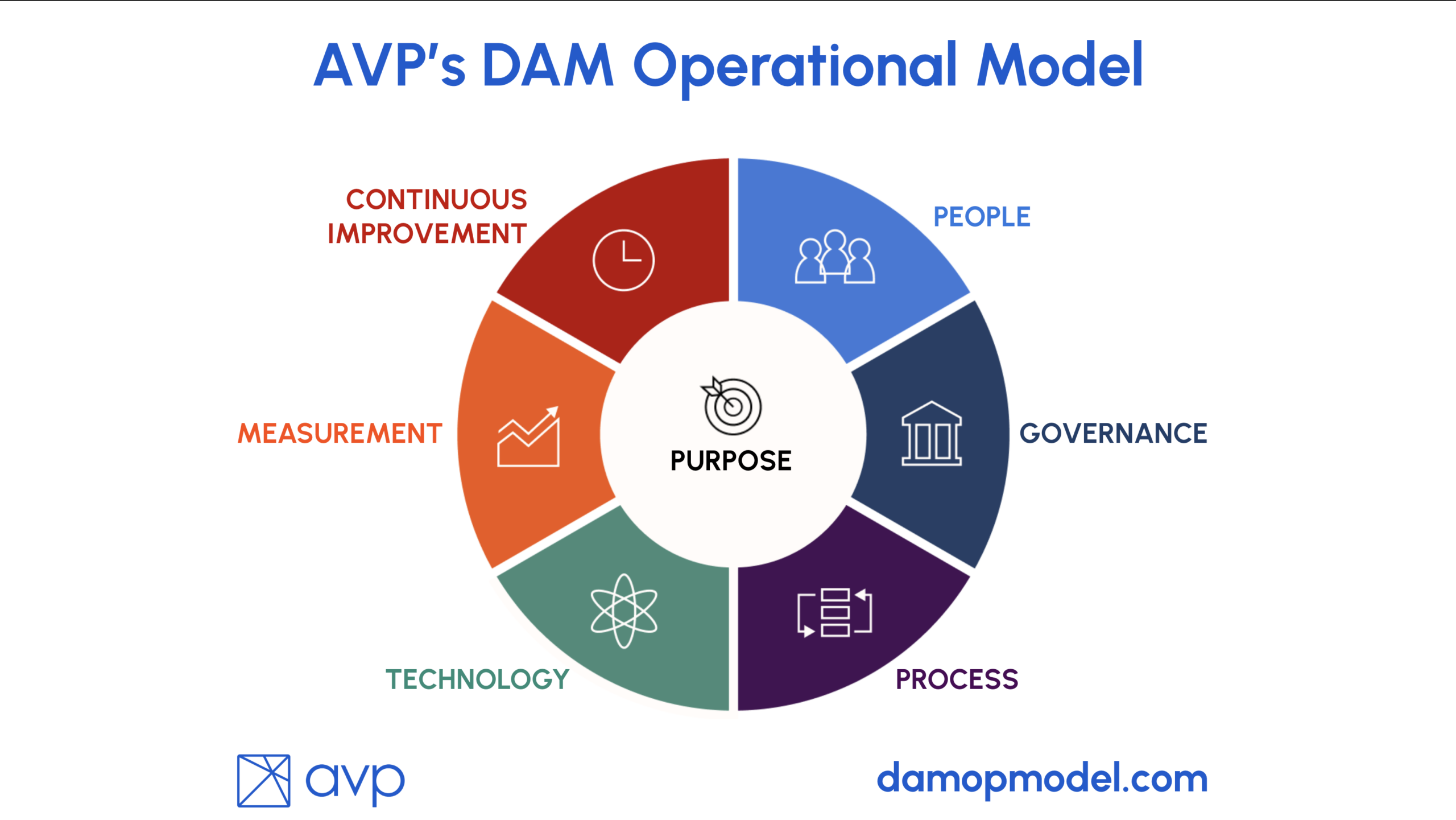
AVP’s Digital Asset Management Technical & Operational Framework is designed to help you do exactly that. It defines what a sustainable DAM program actually requires—not just technology, but everything that supports it.
The framework centers on Purpose, surrounded by six components: People, Governance, Process, Technology, Measurement, and Continuous Improvement. Together, they give you a structured way to identify where your DAM is falling short—and how to fix it.
It’s built on patterns we’ve seen across dozens of DAM programs. The problems are rarely mysterious. They tend to show up in the same places: governance that isn’t followed (or doesn’t exist), technology configured for the wrong users, and a lack of visibility into performance. The framework helps you address each of these in context.
How do I know my DAM needs help?
DAM problems don’t usually announce themselves—they accumulate slowly. A few inconsistent tags, an approval step everyone quietly skips, or a folder structure that stopped making sense two reorganizations ago. By the time users stop trusting the system, the issues have usually been building for a while.
The most common sign the DAM is failing is that people can’t find what they need.
If your users are asking colleagues where files live, storing their own copies locally, or recreating assets that already exist, your taxonomy and metadata aren’t doing what they should.
Low adoption is a close second, and one of the harder ones to diagnose. When people avoid the DAM, the instinct is to blame the interface or the platform. It’s almost never that, though. Unclear policies, inadequate training, and metadata quality are the more common culprits.
Then there’s the ownership question. Who decides what gets uploaded? Who approves assets before they go live? Archives content when it expires?
When no one has clear answers, things begin to fall apart. Files don’t get uploaded, permissions get messy, and the DAM stops being a source of truth users can trust.

And if someone asked you today what percentage of searches return a useful result, or which assets are actually being used, could you answer? Most teams can’t, and it’s one of the first things worth addressing.
Most DAM issues trace back to governance gaps, change management failures, and a lack of measurement—not the platform itself.
What you can do
When something goes wrong with a DAM, the first instinct is to blame the technology—a new platform, a better integration, or a different vendor. That instinct is understandable, but often wrong. AVP’s framework helps you step back and examine the full picture, not just the technology. In most organizations, the biggest issues lie in governance and people—the components that are hardest to see and easiest to overlook.
People
Most DAM programs are underleveraged because of limited staffing behind them.
Someone is managing the DAM on top of two other jobs, governance questions go unanswered because no one is clearly responsible, and onboarding new users falls to whoever has time. You’ll find that this gap will influence all others, and not in a good way.
Governance
Governance is usually where the real work is. Upload standards, naming conventions, roles and responsibilities, permission structures, archiving policies: most organizations have opinions about these things but haven’t written them down anywhere users can find them. (If your governance documentation lives in someone’s inbox, that counts.) When governance lives in one person’s head, it disappears when they leave. Document it, make it accessible, and revisit it whenever your organization experiences change.
Process
Having governance policies is one thing. Getting people to follow them is another. Process is where that gap lives. Map how assets actually move through your organization and look for where things break down: the step everyone skips, the handoff that falls through the cracks, the training that never happened. Change management belongs here too. When you’re asking people to work differently, telling them once and hoping for the best isn’t a plan.
Technology
Many DAM frustrations get blamed on the technology. In reality, a platform can only perform as well as the governance, training, and configuration behind it. If your taxonomy was built around internal assumptions instead of how users actually search, it will underperform on any platform. If features were never properly rolled out, the platform can look like the problem when the real gap is user training. Before you consider switching systems, make sure you understand why the current one isn’t working.
Measurement
This is how you answer your boss. Some of the KPIs that matter most for a DAM program and that will help when your boss asks:
- Search success rate (what percentage of searches return something the user actually uses),
- Asset utilization rate (which assets are being downloaded or shared versus sitting untouched),
- Active user rate (who is in the system and how often),
- Time to asset (how long it takes to find and retrieve what’s needed), and
- Metadata completeness (what percentage of assets have required fields filled).
Get baselines in place and track them over time, and then report them out.
Continuous Improvement
Once the foundation is solid, the work changes. It’s no longer about fixing things that are broken; it’s about keeping a working system humming as your organization evolves. That means building in recurring habits: a scheduled content audit, regular governance reviews, and a way for users to flag problems before they grow. Most organizations reach this stage gradually. The ones that see real success make maintenance routine rather than reactive.
When to bring in help
There’s a lot you can accomplish internally, and this framework gives you a strong place to start. But most DAM teams are already stretched thin (and often a “team” means “you”), and optimization work competes with everything else on the list. Without consistent attention, even well-built programs start to erode.
Outside support helps close that gap. An experienced partner can sit with your team, ask the questions that are hard to ask from the inside, and help you build something that lasts.
It often starts with an assessment to identify where things are breaking down, followed by the real work—incrementally solving those problems together.
The organizations that sustain a well-functioning DAM over time typically have that kind of support: someone who understands the platform and has seen what works elsewhere, and doesn’t have to start from scratch every time a problem comes up.
How you structure that support depends on where your program is. A focused project is a good place to start if the foundation needs work. Ongoing support makes more sense once things are running and you want to keep them that way. AVP can help with both.
Put the framework to work
The checklist on the following pages follows the same seven components: Purpose, People, Governance, Process, Technology, Measurement, and Continuous Improvement. Assign an owner and a due date to each item, work through it over a quarter, and revisit it once a year.
You won’t fix everything at once—and that’s fine. The organizations that end up with a DAM that actually works get there through steady progress, not a single initiative.