The DAM AI Gap Is Real. Here’s How to Close It.
January 15, 2026
The fastest way to tell if your DAM is (un)healthy is to turn on AI.
Because AI does not just make DAM smarter. It makes your DAM’s foundations visible. When the fundamentals are strong, AI accelerates what is already working. When the fundamentals are weak, AI amplifies inconsistency, risk, and cleanup work.
That matters because organizations are being asked to do more with less, and AI has become the default answer. DAM is no longer expected to be a repository. It’s expected to orchestrate content operations, reduce friction, and scale output. But without consistent metadata, clear governance, and operational control, AI can’t deliver that promise. It amplifies whatever is already true in your DAM, including gaps.
AI is proliferating across the DAM ecosystem. Vendors and DAM-adjacent platforms are shipping automated metadata creation, natural language search, and agentic AI at an unprecedented pace. Leaders within organizations are being told to expect dramatic gains in efficiency, automation, and discoverability, often framed as the fastest path to doing more with less.
But a consistent reality is showing up across organizations: many do not yet have the foundations, funding, or control required to leverage AI safely and effectively.

This is what I’m calling the DAM AI Gap: the disconnect between what AI promises and what most DAM programs are actually ready to operationalize.
If you are not seeing results from your DAM or early AI initiatives, it is likely not a technology problem. It is a foundation problem.
The good news is that this gap is solvable and often faster to address than leaders expect when the work is approached with the right experience and a clear path.
The Gap
The pattern is straightforward. Market innovation is moving faster than organizational readiness. Advanced AI capabilities assume a level of maturity that many DAM programs have not yet achieved. Most organizations are still constrained by fundamentals:
- Inconsistent or missing metadata
- Weak or unclear governance and ownership
- No taxonomy or competing taxonomies
- Fragile workflows and uneven adoption
- Half-baked integrations that keep content scattered across systems and shared drives
- Disorganized ecosystem
The ambition is DAM as a system of action, not storage. The reality is uneven data quality, under-resourced teams, and unclear control points. The risk is that AI and automation amplify weakness rather than resolve it.
AI does not replace DAM fundamentals, it depends on them. When the underlying structures are not in place, AI-driven features often create new failure modes. Improved discoverability without strong permissions and rights management can expose content to the wrong audiences.
Automation without oversight can scale mistakes faster than teams can catch them. AI layered onto fragile governance can create noise and unpredictability, which erodes trust and adoption.
In our 2026 DAM Trends survey, the tension was clear: the vision is compelling, but the fear is being pushed to move faster than governance, data quality, and operational control can support.
Most organizations are operating under sustained efficiency pressure. DAM, marketing operations, and content operations teams are being asked to deliver more impact with constrained capacity while also adopting new AI-driven capabilities.
In that environment, the foundational work AI requires is often the first work deferred. Metadata models, taxonomy decisions, governance structures, rights and permission frameworks, workflow integrity, integration design, enablement and operational ownership are hard to prioritize when teams are stretched.
The result is predictable: the organization invests in AI and automation expecting speed and savings, but experiences more cleanup work, higher risk exposure, and slower adoption. Not because the technology failed, but because the operating foundation was never built to support it and accordingly there were unreal expectations of what AI could do.
This is not a story about resistance to change. It is a story about organizations knowing what DAM needs to become and being acutely aware of what can go wrong if they try to get there without fixing the fundamentals.
Closing the Gap and Delivering on the Promise of AI
At AVP, we embrace the potential of AI, but our stance is grounded in truth and readiness.
AI can amplify DAM value, but only when the foundations are sound. If you want to unlock the power of AI, you have to get the foundation in place first. Much of that foundation is what we define as the DAM Operational Model: the operating system that makes DAM sustainable and scalable across people, process, governance, and technology (Learn more about that here.)
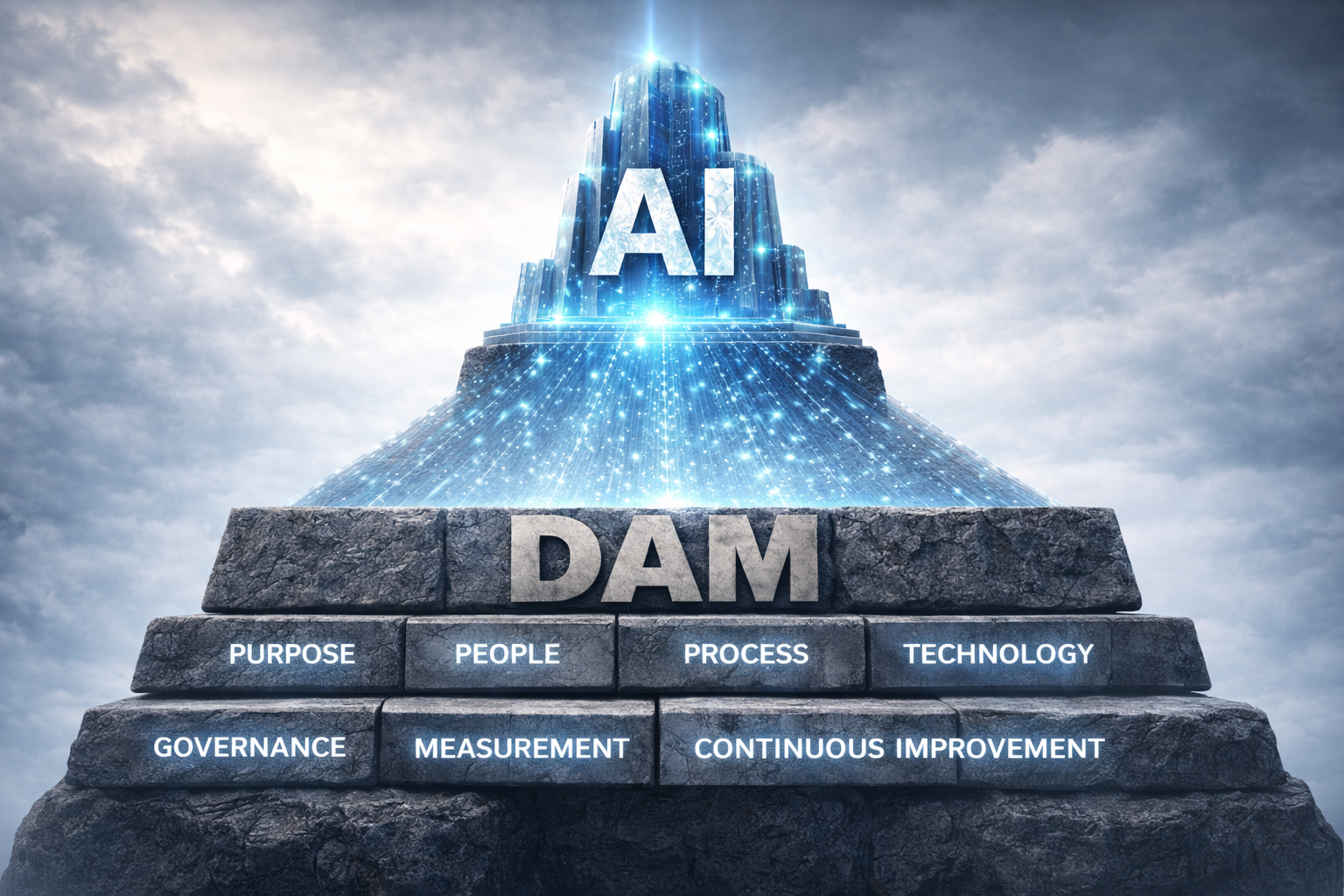
Without it, AI becomes another layer of activity on top of instability, rather than a multiplier of value.
This includes things like:
- A metadata model and taxonomy aligned to how the business finds, governs, and uses content
- Clear governance, ownership, and operating mechanisms that sustain quality over time
- Permissions, rights management, and policy controls that protect the organization as discoverability improves
- Workflows and practices that scale across teams and regions
- Integrations that support end-to-end operations, not isolated repositories
When these fundamentals are in place, the outcomes leaders are looking for become achievable:
- AI works as intended
- Automation becomes reliable
- Rights and intellectual property are protected
- Workflows scale and cycle times drop
- Adoption increases because teams trust the system
- ROI becomes visible and defensible
If your organization is under pressure to move faster with AI, the highest-leverage move is to treat DAM fundamentals as an executive-level capability, not an operational nice-to-have.
That framing also gives DAM practitioners the language they need internally: the work is not “cleanup.” It is risk mitigation, preparedness, efficiency enablement, and value realization. The goal is not to slow down AI. The goal is to make AI safe and effective.
AVP helps organizations close the DAM AI Gap by building the foundation required to make AI safe, scalable, and ROI-driving. We provide the expertise and capacity to:
- Build or rebuild taxonomy and metadata structures
- Establish governance, permissions, and rights management
- Fix workflow and operational bottlenecks
- Stabilize underperforming DAM environments
- Support lean or capacity-constrained teams
- Integrate AI safely and effectively
If you are not seeing the results you expected from DAM or early AI initiatives, start with readiness. Close the foundational gaps that determine whether AI becomes a multiplier or a liability.
Work with AVP to build the DAM foundation that enables safe deployment, scalable operations, and defensible ROI.
DAM delivers on the promise of AI. AVP delivers on the promise of DAM.
Let us know how we can help you.
