Saving And Archiving Are Not The Same
8 January 2013
In my personal life I actively work against saving things. I actively work because it is difficult to not save. Because the opposite of saving is wasting or over-consumption, and those are amoral or unethical. Because there are many urges and compulsions to save. Because not saving involves making a decision, and decisions might be wrong or irreversible or just. too. much. effort.
*****
Why do we save? What is it that compels us?
Value
Monetization
Cultural heritage
Family history
Sentiment
Nostalgia
Ethics
Legal contraints
Mental issues
Expenditures made
Inertia
Just in case
Most likely it is a mix of these, a particolored profile of one’s psyche where the colors bleed and overlap, the dominant field not necessarily the most apparent or even visible at all. Experience, ego, shame, indecisiveness, dreams. These mesh and expand and shrivel and prompt the electrical impulses to save.
*****
Somewhere in here is a fuzzy line zigzagging the patchwork which the divides the reasons we save and reasons we tell ourselves (or potential funders) why we save or should save a particular thing.
We would prefer these to be noble. Sometimes the primary reasons are. Sometimes, though they may ultimately lead to noble seeming ends, the primary reasons are selfish, accidental, or pragmatic.
What matters then is not why we save but how we save. How we ensure that our stuff continues to exist into the future and continues in its ability to be saved by others in the future. This is archiving, not saving. It is the purposeful and controlled selection, arrangement, and documentation of materials, done in a way that is not overly burdensome to a future caretaker, and in a way that allows a future caretaker to continue using the materials and to easily pass them along to the next caretaker.
*****
It lacks romanticism, but that’s okay. It is work. It is what we do. It is why we are professionals and why archives matters. It is how we are professionals and how archives matter.
— Joshua Ranger
Are The Aesthetics Of Decay And The Aesthetics Of Preservation Compatible?
3 January 2013
If decay is a beautiful thing, why are we working so hard to preserve all this archival material?
A facetious statement, perhaps, but an exaggeration that underscores the fact that aesthetics guide many of the decisions we make as archivists and preservationists. We may claim it is for research, or integrity, or, to use the European term, patrimony, but we have to admit that at the base of our decision-making and the actions we take is an aesthetic judgement of value, quality, and beauty. This fact tracks back through the history of preservation in the west at least into the 19th century, such as was expressed with the scrape / anti-scrape conflict that pitted restoration to an idealized original state against maintaining the existing state of a building and repairing it enough to remain standing as the most authentic preservation of cultural heritage.
Why really does this matter, however? We have things correct now with the way we preserve things, or at least we have identified the ideal we strive to attain.
No. We don’t. And we’ll never be close. We’ll never be close because aesthetic values are temporally and culturally — and even individually — bound. The choices we make are destined to be reassessed and found wanting by future generations — just as we have done — until a subsequent future generation reassesses the reassessment and deems our work worthy — just as we have done. It is the burden of culture, the burden of the past, the burden of progeny.
During the Bush II presidency the refrain was “History will judge us as correct”. They were right. At some point, to some degree, it will. And then it won’t. And then will. And then won’t. And then most people will forget why it even mattered.
******************************
I think about this topic whenever I read things like Dave Kehr’s New York Times review of the Blu-ray release of Bill Morrison’s Decasia. The typical refrain that gets me, and that is oft-repeated by commenters and social media-sharers, is something along the lines of an I told you so Schadenfreude that film is the über-medium and digital is a false prophet.
This attitude seems odd in the context of a review of a work made up of clips from severely decayed film (that also happens to be releasing on a digital format). It also seems odd considering the many missteps that have occurred with film as a physical medium which have led to untold problems with preserving it.
But then again, it’s not odd, because much of Kehr’s review is predicated on a belief that because film decays in a way that may still be presentable, and because that decay is beautifully melancholy, film is far superior to digital formats that (according to him) cannot be viewed once damaged or degraded. An aesthetic judgement, to be sure, that is not really tied to the original cinematic works or their context, as well as one that ignores those who document and find beauty in the artefacting and decay of magnetic media and digital content, which, even if it’s not your bag, is still probably 1000x more pleasing than 90 minutes of pink, color-faded acetate.
I point this out not to say that Kehr is wrong — History will do that for me — but to understand or acknowledge how our personal biases influence us even in matters we believe are born out of logic or a studied lack of self-interest, whereas these approaches themselves are a part of aestheticized systems of thought steeped in the murk of history and ancient religions.
That said, okay, I now have to admit that Kehr is wrong. He is wrong in continuing the fetishization of decay and its inextricable link to archives. To me, this is on par with the dusty archive trope, the lost until a heroic researcher discovered it trope, and the temporal dissonance that older things are more well made and longer-lasting but anything over 30 years old is ready to crumble to dust if you try to do anything with it.
(Okay, that last is just a personal affront to the wounded ego of an aging soul.)
But maybe there’s something in that personal affront, something about the conflict of the decaying body housing the strengthening mind, about the degrading reel of film holding content that does not fade except in our memory. Even if its essence does not change, everything becomes something else over time, whether by nature or by our hand.
— Joshua Ranger
Tips on Archiving Family History
2 January 2013
Our very own Bertram Lyons was asked to do a 3-part series for the New York Times Ask an Expert section back in 2013 when he worked at the American Folklife Center at the Library of Congress. Read the questions he was asked and how he answered them.
AVP Holiday Card – 2012
31 December 2012
Artwork by Stephanie Housley from Coral & Tusk
This year we celebrate the 30 year anniversary of the standardization of SMPTE time code – structural and technical metadata which enables frame accurate synchronization, editing and identification of film, video and audio. Widely adopted before the term metadata came into popular use, SMPTE time code became the backbone of production and post-production processes, and it aids caretakers of audiovisual collections in numerous ways. Looking at the history and uses of SMPTE time code, one understands the limitations of the old description ‘data about data’. Metadata is vital information about the things we make and do, and information that lets us do more.
Metadata gives form to things that are otherwise shapeless and ambiguous, deriving value from concepts, information, and objects that appear to have little intrinsic worth. Metadata is the key to our ability to find, unlock, and use information that would otherwise remain obscure or out of reach. It is the reason we can recognize the creator of a work, find the owner of an object, authenticate historic records, discover the content we are looking for, articulate the value of our collections, and effectively manage them.
A search of the New York Times reveals that the term “metadata” came up once between 1970 and 1980. In contrast the term was used 208 times between 2000 and 2010. Not more relevant, just more recognized, metadata is here to stay, and to that we say, hip hip hooray!!!
All Images on this page are copyright protected and may not be reproduced or used without permission from AudioVisual Preservation Solutions.
2012 Archives Year In Review
28 December 2012
Another year in the circular filing cabinet, another year in review. Only difference from the other ones is, I’m right.
Most Interesting Acquisition: One’s Personal Archive From Twitter
Though it hasn’t quite been completely rolled out, Twitter’s announcement that they were targeting year-end for release of tool that would allow users to download all of their tweets was a great boon for those interested in their personal archives. The issue of who owns online data and content — the user or the service provider — continues to be a major unresolved, and growing, conflict. The encroachments we’ve seen this year (*cough* Instagram *cough*) are unlikely to end until the relationship is legally defined, and test rockets will continue to be sent out until the right trajectory is found.
Until then, tools like what Twitter is providing are not only essential to protecting one’s information and assets, but will also open up new ways to research and play with what we create. If only Archivists had been consulted long ago! Make sure the data and materials you put in are what you can get back out whenever you want them in oder to preserve integrity, support usability, and migrate when desired.
Most Archivally Philosophical Documentary: United in Anger: A History of ACT UP and How to Survive a Plague
Two documentaries released in the same year about the same critical moment in world history, centered around some of the same events and people. When Hollywood does this (Prefontaine, Capote, Hitchcock, etc.) it becomes a horserace to see who can release first, and there is invariably a ranking of one as inferior in quality, interpretation, casting, and such, as if one were the straight-to-video low budget knockoff (a la the “Mockbuster“).
In this case, however, we got a lesson in historiography and story-telling. Even within fiction, there are many story lines to follow and many ways to remember or interpret events. Alternate views do not denigrate one another, but create a fuller picture or help the viewer come to their own interpretation or understanding. Indeed, the filmmakers of each documentary (Jim Hubbard and David France) are friends and helped one another get their films made.
Perhaps less philosophical an issue but still in need of underscoring is the reminder that archives matter because stories matter, history matters, and it needs to be remembered and retold, especially when it is something so important as the AIDS crisis and the reaction to it. These events were not that long ago, but memory fades fast. We need archives and the storytellers who use them to stave that off.
*Special Mention: This Is Not a Film
Darn tootin’! It’s a video! Now get offa my lawn!
Most Egregious Use of Archival Material in a Documentary: Chronicle
How did Vince Howard get from Dillon to Seattle and back in high school after graduating? Either Chronicle or Friday Night Lights is totally bogus, or the corruption of college football has seeped down to the high school level!
#waytotakeastand Award for Archives: Let’s Just Solve The File Format Problem
DIY culture seems to be maturing from individual, ephemeral solutions to collaborative, far-reaching problem solving as embodied by groups like Code for America and the Archive Team.
The great thing these groups are doing is taking a stand and saying “Let’s not just complain about a problem or how nothing is being done about it, let’s figure out how to solve it and then just do it.” The Archive Team’s first Let’s Just Solve The Problem effort to create a compendium of file formats and their documentation has the potential to be an essential resource for archivists (and everyone else) who are dealing more and more with digital files and need to find ways to preserve their content for the future.
#yourenothelping Award for Archives: New York Times Review Of “Decasia” Blu-Ray Release
Dave Kehr’s review is part appreciation of the piece and part doomed love ballad to the medium of film. Ignoring the fact that this is a review for an optical disc version of a film, for confusing the issues of access formats (DCP, Blu-ray) vs. original or preservation formats (film or otherwise); and for citing acetate as the “new” film format that will last for hundreds of years (if properly cared for); and for inferring that no “major” archive regards (any) digital media as a preservation format; and for misrepresenting the nature of how digital media is stored and accessed; and for suggesting that scratches and flaking emulsion are what gives a film its character, I say thee pffftttttt. You’re not helping us advocate for how to care for all media types (as we must).
Archivist of the Year: Hurricane Sandy Responders
Being a bit of a homer here, but I’m still amazed by the response I saw to recovering not just archives and other collections after the storm, but also the effort to restore cities, infrastructures, and people’s lives. If you’ve never been through a natural disaster and the aftermath or loss and uncertainty, it’s hard to realize the shellshocked feeling it creates. Perhaps even more difficult to grok is the way people then bond together in support in those times, and how important it is just to see someone else and tacitly commiserate, let alone have them reach out and help in a reminder that, even as specks of cosmic dust, we have a place and some amount of importance in this crazy world.
Kara Van Malssen Invited To Speak At Opening Plenary Of AMIA 2012
4 December 2012
AVPS Senior Consultant Kara Van Malssen and AVPS President Chris Lacinak have been invited to address the Association of Moving Image Archivists’ community as a speaker at the Opening Plenary of the 2012 annual conference in Seattle, WA. As part of the Conference Welcome, the plenary will take place this Wednesday, December 5th following the annual awards ceremony. Chris and Kara will be speaking about collaborative efforts to help flooded media collections during the recent Hurricane Sandy disaster, including the work AVPS, Erik Piil, NYU MIAP and other volunteers did to help salvage the flooded collection at Eyebeam Art & Technology Gallery. Be sure to check out the reception and talk, and look for Chris and Kara at the conference if you’re there!
Disaster Response Information & Assistance
16 November 2012
In the wake of Hurricane Sandy we compiled a list of disaster response resources such as guidelines, advisory services, relief grant opportunities, and aggregate sites, especially focusing on resources related to audiovisual assets. These resources are pertinent to any type of disaster, not just hurricanes and floods. In our experience implementing such efforts to assist people affected by the flooding, the fact was heavily underscored that an emergency preparedness plan alleviates much of the stress and uncertainty.
We were overwhelmed by the response we saw throughout the archiving and arts community, from volunteers, and from those outside the region lending their support and spreading advice through social media. Twitter, you’re all right.
*Audiovisual Specific*
Association of Moving Image Archivists: Disaster – First Actions: First Actions for Film, Tape and Discs
National Film & Sound Archive Australia: First aid for water damage
Washing and Handling Wet Film (video demonstration): http://www.folkstreams.net/vafp/clip.php?id=63
Disaster Recovery for Films in Flooded Areas by Mick Newnham
Specs Bros Hurricane and Flood Recovery Info for Video and Audiotape http://www.specsbros.com/hflood_recover.htm
And Disaster Recovery Checklist: http://www.specsbros.com/recover.html
National Park Service Conserv-O-Gram Salvage of Water Damaged Collections: Paper, Non-Paper Based, Objects, Natural History, Textiles
National Film & Sound Archive Australia Disaster Planning : http://www.nfsa.gov.au/preservation/handbook/disaster-planning/
*Direct Response & Support*
Northeast Document Conservation Center 24 hour Disaster Assistance Hotline: (978) 470-1010
American Institute for Conservation of Historic and Artistic Works Disaster Response & Recovery Hotline: (202) 661-8068
And the website: http://www.conservation-us.org/index.cfm?fuseaction=Page.viewPage&pageId=695
Lyrasis Disaster Assistance:
Phone – (800) 999-8558
Email – [email protected]
Website – Disaster Assistance
Mid-Atlantic Region Archives Conference Disaster Relief Fund: http://www.marac.info/disaster-relief–
SAA National Disaster Recovery Fund for Archives: http://www2.archivists.org/news/2008/national-disaster-recovery-fund-for-archives
New York State Archives Disaster Assistance: http://www.archives.nysed.gov/a/records/mr_disaster.shtml
*Multi-topic & Aggregated Resources*
Preservation Response & Recovery Resources from Library of Congress: http://www.loc.gov/preservation/emergprep/recovery.html
NARA Records Emergency Information : http://www.archives.gov/preservation/records-emergency/
METRO Disaster Recovery Resources List : http://metro.org/articles/disaster-recovery-resources/
Is It Wrong To Focus On Saving Mere Things After A Disaster?
5 November 2012
One of the great conflicts I have with the choice of my career is the primary focus on material objects, on plastic things. Sure, those things hold important cultural content, but int he end they (generally) are not a matter of life or death. They are not people who are suffering, who could use the resources and care we give to these piles of…stuff.
One makes one’s choices in life, and, realistically, most work is not immediately critical to survival. But this issue I have is brought into sharp relief at times like these as we recover from Hurricane Sandy. I’m very proud of the work we at AVPS and all the other volunteers have done at Eyebeam Art & Technology Center and with other media collections to help salvage their materials. (See our Facebook page for photos and documentation of the effort.) The mobilization effort is so impressive, and seeing our colleagues in the field use their expertise and passion to save a collections before it is completely (and quickly) lost is just, wow.
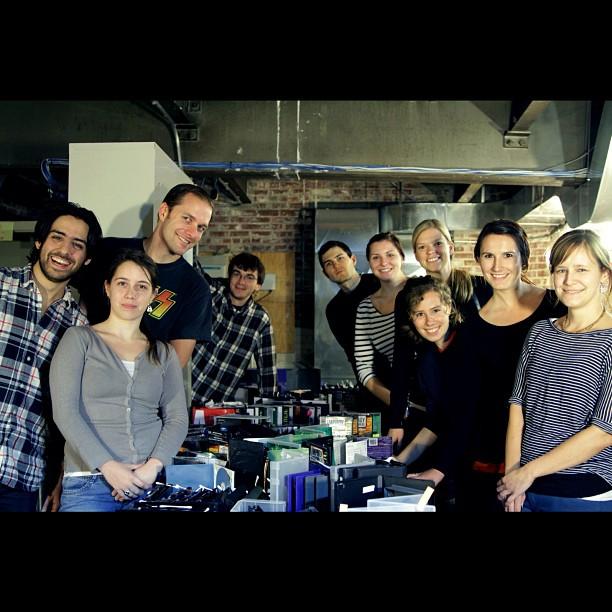
But at the same time, one wonders (or maybe just I do), what if we had funneled just a fragment of that effort into taking food and equipment to people in the hard hit areas like the Rockaways and Staten Island, or into volunteering at medical shelters to care for the sick and elderly, or going into houses to help clean up and rebuild? What are mounds of DVDs and reels of magnetic tape compared to the life of a stranded shut in who needs warm clothes and a hot meal, or someone who has lost their home?
***************************
In a less drastic scenario, this kind of question parallels the issue of general funding for the arts, libraries and archives, and preservation. However in that arena I have no problem adamantly averring that yes, these institutions and efforts need more resources and money because they matter. Arts and Humanistic learning bring texture and richness to our lives. They connect us to others, in the present, past, and (if we’re lucky) the future. We understand the things that make life physically possible to live — food, water, shelter, clothing — but what is that capability without the things that make life worth living — family, community, belief (in something or nothing), pleasurable food and drink, entertainment, and art.
And in the aftermath of tragedy — the brunt of which many of us were lucky enough to escape relatively unscathed — it is also important to recall the importance of quality of life, as well as to understand our roles and abilities to contribute as part of a functioning, livable society. We do what we can and we help in the ways that other people cannot help themselves.
In this way the kind of work done at Eyebeam is not about material stuff. It’s about community, about reaching out to someone to say what you do or what you care about matters to others. It makes our lives better. We want to help maintain that fact and share it with others, and we want to thank you.
Can Better Metadata Help Better Manage Costs And Disaster Recovery
1 November 2012
Based primarily (I myself believe) on my sterling undergrad honors thesis on the topic of African-American Women’s 19th Century Spiritual Personal Narratives, I was able to procure a temporary staffing position as a file clerk with a workers compensation and general liability insurance company.
Don’t let anyone tell you that a Humanities degree is not versatile.
I ended up staying on, working in several different positions until I careened myself into the data analysis and reporting side of things. Much of the work was basic number crunching — how many claims, frequencies, how much was being spent — but an actually interesting part of the job was developing reports that would be the basis of risk management studies, such as looking at injury types across periods, locations, or jobs to see if there may be some preventable cause. Sure, maybe in the end it was ultimately about saving money, but I preferred to think about the efforts as trying to ensure that workers were not put in harmful or injurious conditions in order to create a safer, more pleasant workplace.
Don’t let anyone tell you that a cynic with a Humanities degree is not actually a big idealistic slob.
Another interesting thing I learned on the job was the different types of medical care models — such as preventative, curative, and palliative — and how they were applied on a health care continuum. In truth, though I may joke about that period in my life because one is supposed to joke about working in insurance, I picked up a lot in that career that has shaped how I think about preservation and collection management as, in a way, risk management or risk reduction. Essentially, we know that the assets are decaying, becoming obsolete, or can get damaged, so we work in ways at various points in the item’s lifecycle to prevent (for a time), retard, or ameliorate those events.
This is on my mind right now because we’re all waiting to hear what the impact of Hurricane Sandy on library, archive, museum, and other collections will end up being — not to mention the many personal collections endangered that we will probably not hear as much about but should still be a concern. We’re all bracing for what could be a high degree of palliative or curative care to salvage collections.
In an event like this it is uncertain precisely how much impact preventative care had. Yes, there are certain things which help, but water and wind do what they want. This is the bind of preventative measures (or insurance for that matter) — you don’t really know how beneficial (or useless) it may be until a triggering event occurs, or such an event may never occur, so there’s always the gamble to do without just to save costs.
Maybe we need another term that’s something more like Preparative — making sure that in the event of a disaster you are prepared to respond to it and have done things to prepare for smoothly managing the recovery. Many of these things would be covered in a disaster preparedness plan, such as having a phone tree and proper equipment and guidelines for recovering materials, but based on some of my experiences I feel there is one thing we are not focusing enough efforts on that would help us be more prepared — the creation of centralized, analyzable asset records at or near item-level.
How can this help? I’ve written a white paper on the topic posted today in our Papers & Presentations section, (“Insuring Media Archives & Leveraging Data Management as a Risk Reduction Solution”). Essentially, my thesis is that if you can’t quantify your collection pre-disaster, it will be impossible to do so afterwards, leading to an increased potential for a contentious claims process, duplicative or inefficient remediation efforts that waste resources, and greater costs down the road for coverage or self-funded remediation. Pre-disaster, a poorly quantified collection may result in over or under coverage, or a lack of realization regarding potential strategies for reducing risk to the most valuable content in a collection. This last point is very important to audiovisual and photographic collections where there is frequent duplication or versioning of contents, and management efforts should be focused on original or highest quality items.
Processing backlogs, incomplete records, or dis-aggregated records sets are a frequent issue for institutions, and the resources to alleviate those problems are often lacking. In reality, fuller records can impact many other cost points, such as the insurance topic discussed in my paper, time spent assisting patrons in discovery, or legal issues that require the recovery and review of data. Not to ignore the recovery efforts that are on-going and will continue, but for institutions not affected by Sandy or who escaped catastrophe, these events should be an eye-opener to the potential for risk. We need to start weighing these factors or risk, cost, and benefit and use them as arguments for improved funding for record creation, record management systems, and other data-centric areas that impact how well we can do our work and protect our collections.
— Joshua Ranger
Insuring Media Archives & Leveraging Data Management As A Risk Reduction Solution
1 November 2012
Creating item level records for archival media collections is seen as a high-cost investment, but it may help save costs and efforts in the long run, especially in the event of a major loss due to disaster.
