Blog
Documenting Your Digital Asset Management Criteria
1 August 2025
Choosing a Digital Asset Management (DAM) system isn’t just about comparing feature lists from vendor websites. It starts with understanding your organization’s specific digital asset management criteria: what assets you manage, how your teams work, what’s not working, and where you’re headed. To make good decisions, you need clear documentation that captures those needs in a reusable, structured format.
This article offers practical guidance to help you build that foundation, with examples and templates you can reuse throughout your planning process, including RFP development, vendor evaluations, and internal alignment.
1. Start with a Centralized, Collaborative Document
Use a collaborative tool like Google Sheets, SharePoint, Excel, or AirTable to keep your documentation organized and visible to stakeholders. Create tabs that reflect the key areas in this article (e.g., Stakeholders, Usage Scenarios, Assets, Metadata), and structure your notes in a clear, sortable format. This makes it easier to spot patterns, prioritize shared needs, and track where each requirement came from. Your spreadsheet becomes a central source of truth for drafting your RFP, comparing vendors, and aligning internally.
2. Interview Stakeholders and Track Themes
Record short interviews (with permission) with stakeholders in marketing, creative, archives, IT, legal, and other teams that work with digital assets. Focus on what tools they use, where processes break down, and what they wish were easier.
Skip surveys. Interviews offer deeper insight into workflows, pain points, and expectations, and help you capture the language people actually use. These conversations will ground your future steps, ensuring the DAM supports real-world needs.
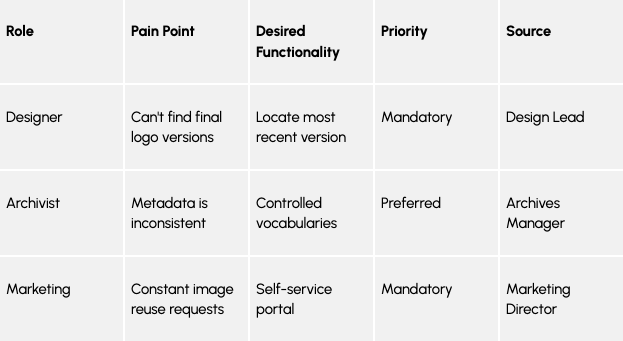
Tip: “Role” refers to the type of user experiencing the need (e.g., Designer, Archivist), while “Source” refers to the specific person or department who shared that insight during interviews (e.g., Design Lead, Archives Manager). This helps you see how broadly a need applies and trace it back to the original stakeholder if you need more context later.
3. Inventory Your Digital Assets (Rough Counts Are Fine)
You don’t need a full audit, just a rough idea of what you have, where it is, and who uses it. Include file types, volume estimates, and storage sizes:
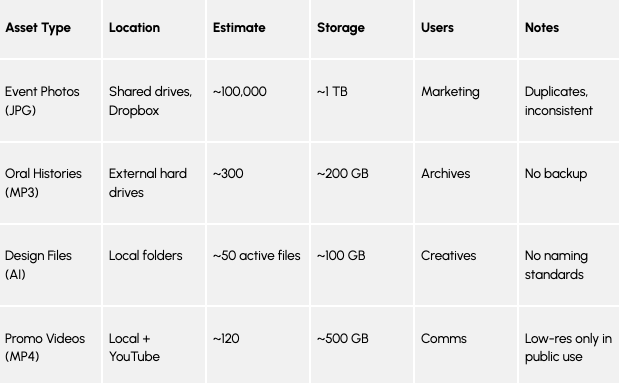
This information is essential for planning migration and estimating storage needs, and vendors will need a summarized version to provide accurate costs in their proposals.
4. Look for Metadata (Even If You Don’t Call It That)
Even if you’re not using a formal metadata system yet, your team is probably tracking important information about your assets, like who created them, what they’re about, or how they can be used. That’s metadata.
Start by identifying what kind of information you already track and where it lives. It could be:
- In filenames or folder names
- In a spreadsheet
- Stored inside the file itself (like photo properties and technical information about the file)
You might also hear terms like:
- Metadata schema: This just means a consistent set of fields used to describe your assets, for example, “Photographer,” “Date Taken,” or “Usage Rights.” If you’re not using one yet, that’s okay. Start by listing what you are tracking.
- Embedded metadata: This is metadata that’s saved inside the file itself. For example, a photo might include the date it was taken, the camera model, or GPS location.
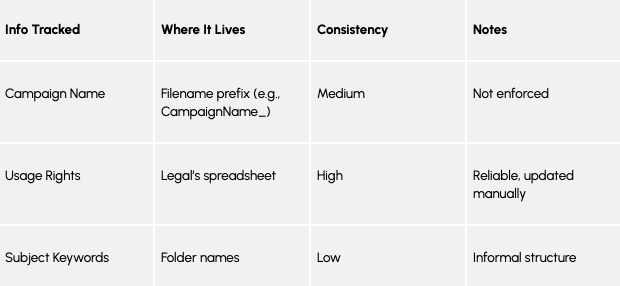
You might be tracking more metadata than you realize. Look around, especially in shared drives, naming patterns, or that old spreadsheet someone still updates manually. This will help you decide what metadata to keep as-is, what to standardize, and what metadata to capture automatically (with AI) once your DAM is in place.
5. Document Integration Needs Across Systems
Most DAM systems won’t stand alone. They often need to connect to tools your team already uses. These could include your website CMS, creative tools from Adobe, or archives and records systems.
Think about what other tools or systems it should work with.
Start by making a list of all the software your team already uses—like design programs, content management systems, cloud storage, or social media tools. Then, for each one, ask:
“What do we need the DAM to do with this system?”
For example:
- Your designers might want to pull images straight from the DAM while working in Adobe Creative Cloud, without switching between tools.
- Your marketing team might need the DAM to automatically send approved images to your website or social media platform.
Making this list now will help you choose a digital asset management (DAM) system that plays nicely with the rest of your tech setup—and saves your team time down the line.
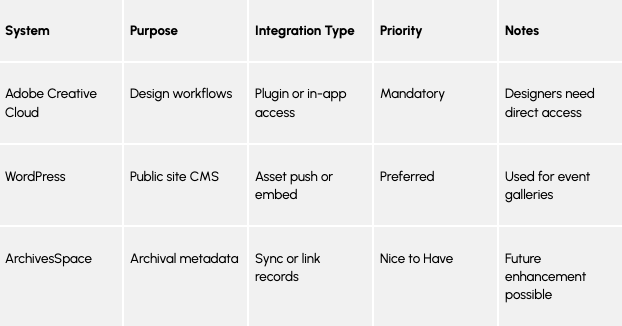
Even if you’re not sure how the integration will work yet, noting your needs now gives vendors and IT something concrete to work with later.
6. Capture Technical Requirements Up Front
Before you choose a digital asset management system, it’s important to document any technical expectations your IT team or organization has. These might include how users will log in, where the system is hosted, or what kind of security and accessibility standards it needs to meet.
Start with questions like:
- Does your organization require Single Sign-On (SSO)?
- Do you prefer a cloud-based system or one hosted internally?
- Are there file size limits you need to support?
- Do you have accessibility or compliance requirements?
No need for a technical spec. Just capture the basics to share with vendors.
Final Thoughts
Take your time with documenting your digital asset management needs. It can be tempting to jump straight into vendor conversations, but a clear, well-documented foundation will save time, reduce confusion, and support better decisions later on.
And don’t try to do it alone. Involve the people who will use the DAM every day. Their input will save you from surprises later, and probably make the system better for everyone.
Appendix A. DAM Selection Planning Checklist
Once you’ve done some of this early prework, like interviewing stakeholders and identifying your assets, you can move on to this checklist. It’s comprehensive and may feel overwhelming at first, but you don’t have to tackle it all at once. Take it step by step. Collaborate with your main stakeholders. Check in with IT. Use this list to structure your planning, shape your RFP, and guide vendor conversations.
The good news is, if you’ve done the work above, this list will feel much more manageable and actionable.
Strategic Foundation
- What purpose will your DAM system serve, and what problems is it meant to solve?
- What does success look like, and how will you measure it?
- What does Phase 1 (Minimum Viable Product) look like?
Users & Stakeholders
- Who are your key users and stakeholders?
- Have you conducted recorded interviews with them?
- What pain points and needs did they share?
- Have you tracked themes across roles and prioritized them?
- Who will administer the DAM system?
Usage Scenarios & Requirements
- Have you written future-focused usage scenarios for core roles?
- Have you written user stories that describe desired functionality?
- Are your requirements categorized as Mandatory / Preferred / Nice to Have?
- Are sources (departments, individuals) attributed to each requirement?
Assets & Storage
- What types of digital assets do you manage? (e.g., images, videos, audio, 3D)
- Where are they stored now? (shared drives, cloud storage, hard drives)
- What’s the estimated volume (e.g., number of files) and storage size (e.g., in TB)?
- Who uses or owns each asset type?
- Are any assets at risk (e.g., no backups, fragile storage media)?
Metadata & Organization
- What metadata do you track, even informally (e.g., in file names or spreadsheets)?
- Where does that metadata live (e.g., embedded, folder structures, Excel)?
- Do you have consistent file naming conventions?
- Do you use any controlled vocabularies or taxonomies?
Workflow & Lifecycle
- Who creates, reviews, approves, and publishes digital assets?
- What do your current workflows look like, and where are the pain points?
- Do you distinguish between Work in Progress (WIP) and Final assets?
- How are assets currently tagged and ingested?
- Who will manage migration and tagging into the new DAM?
Digital Preservation
- Do any assets need long-term preservation beyond active use?
- Are there embargoing, archiving, or retention policy requirements?
- Will the DAM integrate with a preservation system or strategy?
Licensing & Rights
- Are you currently tracking usage rights and license information?
- Do you know which channels, regions, and formats assets are approved for?
- Are any licenses expired, missing, or uncertain?
- How will user roles, permissions, and security be defined in the DAM?
UX / UI
- What should the user experience be like for search, upload, and browsing?
- Do you need features like thumbnails, preview players, or 3D viewers?
- Do you need multilingual interface support?
- How will different user types (e.g., casual vs. power users) interact with the system?
Integration Requirements
- What systems should the DAM integrate with (e.g., CMS, PIM, Adobe CC)?
- What kind of integrations do you need (e.g., push/pull assets, metadata sync)?
- Are any integrations vendor-supported or likely to require customization?
- Which integrations are Mandatory, Preferred, or Nice to Have?
Technical Requirements
- Do you require SaaS (cloud-based) or on-premise deployment?
- Is SSO (Single Sign-On) required (e.g., via SAML or OAuth2)?
- Are there preferred storage providers or data residency requirements?
- What is the max file size or upload threshold?
- Do you need accessibility compliance (e.g., WCAG 2.1 AA)?
- Will the DAM need to support public delivery of assets with secure access?
Timeline & Budget
- What is your ideal timeline for selection, contracting, and go-live?
- What is your estimated first-year cost?
- What is your projected ongoing cost (e.g., storage, licensing, support)?
- Will implementation be phased or rolled out all at once?
A DAMn Good Investment
24 June 2025
When the going gets tough, the tough get investing.
With economic instability, the pressure is on leaders to tighten belts yet remain top of mind for target markets. In 2025, the global economy has been wildly unpredictable with tariffs, layoffs, and consumer confidence unstable. And, one of the biggest mistakes I see business leaders make during times of uncertainty is cutting their marketing and advertising budgets altogether. To unlock the full potential of a company’s data for informed decision-making, it is essential that data be accurately recorded, securely stored, and properly analyzed. This becomes especially critical during economic downturns, when financial scrutiny intensifies and every margin matters. Data presented to prospects and existing customers must be precise to ensure that services and differentiators are clearly and correctly communicated. Internally, the accuracy of data shared with executives and analysts can directly influence client retention, strategic direction, and budget planning.
This is also a matter of operational efficiency. Even with effective employee training, the benefits can only be realized if teams are working from a consistent and reliable source of truth … DAM. Establishing this foundation is an investment that relies more on strategic time allocation than significant capital expenditure. To position itself for future growth, a company cannot afford to be complacent when evaluating potential technology investments. In a fast-moving digital landscape, organizations that delay improvements during slow periods risk falling behind. In contrast, companies that make deliberate investments—whether through new systems or by dedicating employee time to development and training—will be better prepared to seize emerging opportunities and showcase their competitive advantages as conditions improve.
This is a good time to invest in DAM.
Change is a Good Investment
Change is as present as it is pervasive. It is good to recognize, acknowledge and accept that change is happening in business, and to learn not only what that means for you and your team, but to be ready for those new opportunities. So, why do we change?
- We change to advance forward.
- We change to make ourselves stronger.
- We change to adapt to new situations.
Without change, there would be no improvements. If business is about growing, expanding and making things better for your customers, then what changes are you making? As many of us begin to see future recovery, I too look to the horizon and know that better days are ahead for us all. Whether you’re undertaking an improvement, an upgrade or modernization, whatever you call it, any such effort is holistic by design, encompassing all aspects of business. Many businesses have taken this time to focus on improving all aspects of their business that affect people, process, and technology. This is about good and positive access to information from many systems to not hinder but enable our work. Watch for signs and respond well. Improvement for all is a good thing. In business, we always aspire for stability but need to be prepared for the opposite. This is about both insurance, and investment.
Invest in DAM
The demand to deliver successful and sustainable business outcomes with our DAM systems often collides with transitioning business models within marketing operations, creative services, IT, or the enterprise. You need to take a hard look at the marketing and business operations and technology consumption with an eye toward optimizing processes, reducing time to market for marketing materials, and improving consumer engagement and personalization with better data capture and analysis.
Time to Transform
To respond quickly to these expectations, we need DAM to work within an effective transformational business strategy that involves the enterprise. Whether you view digital transformation as technology, customer engagement, or marketing and sales, intelligent operations coordinate these efforts towards a unified goal. DAM is strengthened when working as part of an enterprise digital transformation strategy, which considers content management from multiple perspectives, including knowledge, rights and data. Using DAM effectively can deliver knowledge and measurable cost savings, deliver time to market gains, and deliver greater brand voice consistency — valuable and meaningful effects for your digital strategy foundation.
Future-Proof your Content
Consider the opportunity in effective metadata governance: do you have documented workflows for metadata maintenance? Are you future-proofing your evergreen content and data? Remember to listen to your users, to keep up to date and aware of your digital assets, and leverage good documentation, reporting, and analytics to help you learn, grow and be prepared. If you are not learning, you are not growing. If you are not measuring, then you are not questioning, and then you are truly not learning.
Conclusion
Keep the lights on. Now is the time to get smart and strategic with your money to ensure you can weather the current unpredictability and even come out ahead. Tariffs, recession fears, rising prices, and potential layoffs dominate headlines right now. As you look to the second half of the year, this might be causing you to take a close look at budget forecasts and reevaluate spending.
Play the long game. Marketing is a long-term strategy, and DAM is a cornerstone of Marketing efforts and operations. More than ever, there is a direct need for DAM to serve as a core application within the enterprise to manage these assets. The need for DAM remains strong and continues to support strategic organizational initiatives at all levels. DAM provides, more than ever, value in:
- Reducing Costs
- Generating new revenue opportunities
- Improving market or brand perception and competitiveness
- Reducing the cost of initiatives that consume DAM services
The decision to implement a DAM isn’t one to take lightly. It is a step in the right direction to gain operational and intellectual control of your digital assets. DAM is essential to growth as it is responsible for how the organization’s assets will be efficiently and effectively managed in its daily operations.
A DAMn good investment to me.
The Enola Gay is Not Gay: Metadata Matters
12 March 2025
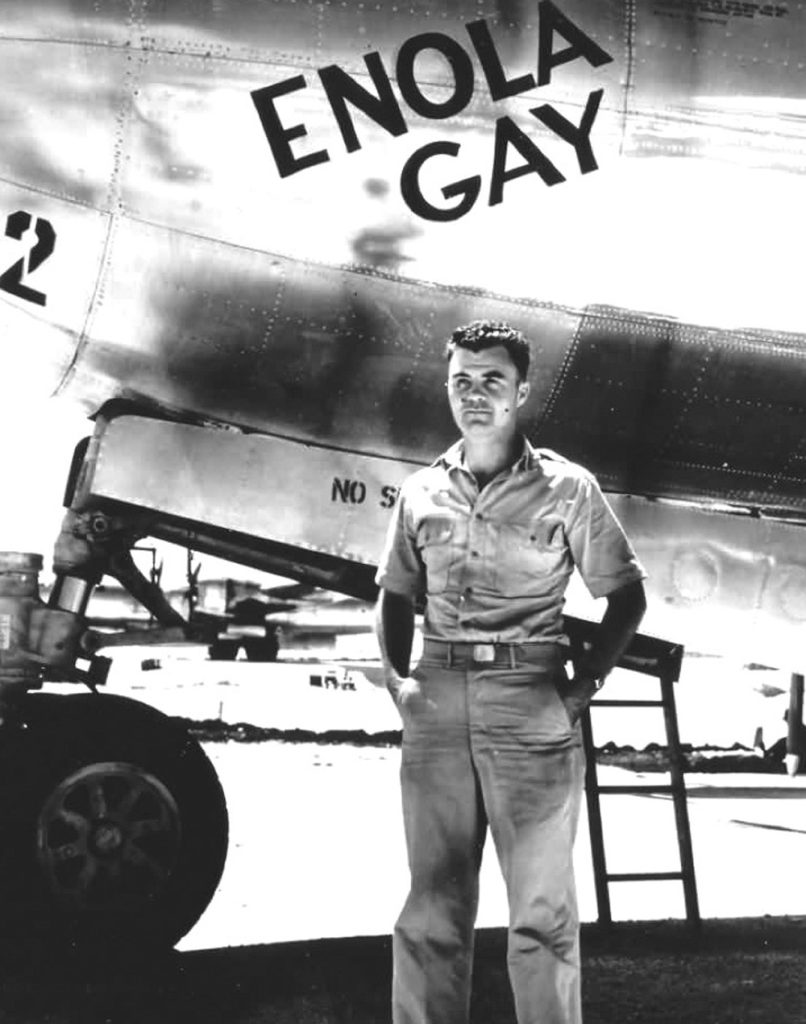
I cannot be any clearer in my words when I write that the Enola Gay is not “gay.” This misuse of metadata to search and purge is not only irresponsible, but egregious and frightening to happen in 2025. And in case you do not know, the Enola Gay was named for pilot Colonel Paul Tibbetts Jr.’s mother, Enola Gay Tibbets. Also, not “gay.”
In a both absurd and astonishing story of access gone wrong, I was gob smacked to read this past week of how historical records were identified and flagged by the United States government for their metadata for something which is untrue, unjust, and unbelievable. The Associated Press broke the story that the US Department of Defense flagged tens of thousands of photos for deletion as part of a purge targeting DEI-related materials following the President’s executive order eliminating DEI programs across the federal government.
Here are the facts:
- Among the items flagged for deletion is the World War II Enola Gay aircraft, which bears the name of Enola Gay Tibbets, the mother of military pilot Paul Tibbets.
- The AP, citing a military database confirmed by U.S. officials, also reported other photos and posts containing the word “gay” were flagged for deletion, including references to people who have the last name “Gay.”
- The marks for deletion target women and people of color the most, the AP reported, including references to the country’s first Black military pilots and mentions of commemorative months, including Women’s History Month.
Ask yourself, what’s in a word? Well, everything. Language is always in a state of change, with new words and meanings being created – this happens quickly and globally, often in ephemeral ways that can take time to permeate into daily awareness. It is important to keep current, and up to date on potential business impacts. And if we accept the fact that your metadata needs to adapt to stay relevant, then ask yourself if your metadata is out of date? Has the meaning changed? Is it damaging? Is it something new? If it is, then yes, this is an opportunity for good changes to be made and socialized. But in this situation, the word “gay” as a search and purge term was just so wrongly misused with an archival record of the actual, “Enola Gay” airplane.
In another similarly astonishing example of access, the New York Times revealed last week that the US government has flagged 197 words to “limit or avoid.” These words range from such examples as activism, anti-racism, diversity, LGBTQ, trans, victim, and more. Some ordered the removal of these words from public-facing websites or ordered the elimination of other materials (including school curricula) in which they might be included. In other cases, federal agency managers advised caution in the terms’ usage without instituting an outright ban. Additionally, the presence of some terms was used to automatically flag for review some grant proposals and contracts that could conflict with President Trump’s executive orders.
But what is happening here in these two incidents shows not only the power in our words, but how the powerful may misuse those words. Let us all consider this with humanity and respect. Without facts that are authentic, authoritative, and replete with respect, trust will be hard to build. Information is coming at us from so many sources. This complexity is being compounded by the increasing rate of content production on social media. And yet, trust is hard to come by. Social media is filled with falsehoods, misinformation which is a fashionable synonym for lies. Irresponsible authors help propagate misinformation and confusion in the race to be first with the so-called facts to feed to the masses. Thanks to the democratic and principled goals embodied by the freedom of the press, the media can assume the role of metadata steward, one who manages language, and assists in its governance.
If data is the language upon which our modern society will be built, then metadata will be its grammar, the construction of its meaning, the building for its content, and the ability to understand what data can be for us all. Metadata matters because it gives structure and meaning to the data associated with all that we do in our business and personal transactions. Metadata matters because it tells you where your content came from, where it is going, and how it can be used. It is both identification and discovery; it’s about access.
Think of metadata governance as language diplomacy. Governance is about the ability to enable strategic alignment, to facilitate change, and maintain integrity. The best way to plan for change is to apply an effective layer of governance to your metadata. Metadata is about meaning and must change with societal norms in a respectful and inclusive manner. If we accept that language is alive, then we must accept that language will grow, evolve, and change over time. Some things need to change as a matter of respect, and other things change as a matter of sociopolitical cultural changes in the words we use and their meanings.
I proudly acknowledge and welcome the quote by author Angela Duckworth who avows, “language is one way to cultivate hope; people can learn to learn.” We love language, in particular the way in which words are used to describe and imbue not only emotion into their meaning, but in the descriptive, structural, and administrative elements that define our documents, photos, videos and other artefacts in our history and in our present. Metadata matters in how meaning is expressed in the words being used. I look forward to a future where data has been grounded in good governance and the ability to present itself as accurate, authoritative, and authentic. Identify trusted sources of information, mute the “noise” and corrupted information on social media and take the time to evaluate what has been presented.
Let us all recognize this, acknowledge this change in our language, and show respect where respect is due.
Disclaimer
I am many things, but most certainly not a robot. It seems awkward to have to provide such a disclaimer, but I wrote this article myself, and no AI was involved in its creation.
Not a robot, but a human.
Sources
2 – https://www.nytimes.com/interactive/2025/03/07/us/trump-federal-agencies-websites-words-dei.html
