Blog
The Expert Guide to Establishing a Metadata Strategy for your DAM
27 May 2026
Introduction
Metadata is data about data; this is the information used to describe digital files. In digital asset management (DAM), metadata is what you add to your brand assets to organize them and make sure the right ones appear when people search.
People are used to searching on Google or using chat-based interfaces like ChatGPT to get information. They expect the same level of accuracy, speed, and results from their DAM. Metadata is the foundation that makes that search quality possible.
Without metadata, assets don’t show up in search results, so your DAM is just a glorified repository for storing files, like a shared server.
Good quality metadata doesn’t happen by accident, though. You need a clear structure for your metadata, as well as defined ownership and governance, to provide a solid foundation for your search experience and your whole DAM — especially at enterprise scale. Without a strategy to document this structure and governance, metadata quality declines over time, making it increasingly difficult for users to find files within your DAM.
This guide is designed to help first-time DAM users and experienced pros: First-time users get a guide to building their metadata strategy from the ground up, while experienced pros get some practical tips and recommendations for revisiting their established metadata strategy to make it more valuable for their organization. Use the table of contents and navigation links within the guide to jump to the relevant sections.
This guide is produced by AVP and Frontify. AVP provides platform-neutral digital asset management consulting services to help companies get the most from their DAM system. Frontify is the DAM for leading brands. Its unified platform combines asset management, brand guidelines, templates, and AI to provide a central source of truth for brands.
Table of Contents
- Introduction
- 01 — Building a metadata strategy from scratch
- 02 — Governance and adoption
- 03 — AI, automation, and the future of metadata
- 04 — Measuring metadata success
- 05 — Revisiting and rebuilding your metadata strategy
- 06 — How AVP supports smarter metadata management
01 — Building a metadata strategy from scratch
When you’re implementing a DAM system for the first time, getting metadata right will make all the difference to how your system gets adopted and whether users can easily find your assets. Here’s how to build your strategy from the ground up and get it right from day one.
Think beyond search
Search is the most visible benefit of metadata, but it’s so much more than that. Think of it as the control layer that enables the following:
Brand consistency: Users can check that files are approved and that they’re using the latest version of a brand asset.
Speed to market: Users can publish approved assets more quickly and avoid recreating files from scratch when they can’t find the originals.
Governance and risk mitigation: Users and admins can check usage permissions, rights expiry dates, and legal compliance to ensure there are no expired assets in the DAM.
If you think about metadata only in terms of search functionality, you downplay its strategic importance and risk under-investing in your metadata process from the start. “Search is the immediate and visible benefit of good metadata,” explains John Horodyski, Managing Director at AVP. “But the true strategic value of good metadata is that it gives your organization intellectual control and effective business management of all your digital files and assets.”
Start with minimum viable metadata
“We often use the Dublin Core metadata standard as a starting point,” says Horodyski. “It gives us a set of 15 core fields to start within, then we edit or expand as needed and often end up in the sweet spot of 16-20 core metadata fields.”
Your metadata strategy needs to balance quality and quantity. Consider how much metadata you need in order to organize files without placing too much of a burden on the people adding files to your DAM. Some DAM platforms like Frontify provide automatic tagging functionality, which reduces the manual work involved in metadata creation.
Start by mapping your core metadata fields, aiming for no more than 20 to reduce the cognitive load when adding new files. Assess whether each field is useful for search, governance, reporting, or automation.
Example core metadata fields
- File name/title
- Audience
- Dates (creation, uploaded, embargo, expiration)
- Creator
- Channel
- Campaign or initiative
- Asset type
- Brand or business unit
- Region
- Description
- Owner
- Rights: usage rights/expiration
- Language(s)
- EXIF Data (format, size, resolution, length, dimension)
- Approval status
Remember, this is just the starting point for your metadata. Make your metadata schema extensible so it can grow and evolve as your business and asset needs change. For example, if you start using particular tags or keywords to describe assets, they can become new metadata fields in the future.
Choosing metadata field types
According to the National Information Standards Organization (NISO), there are three types of metadata:
Descriptive metadata: for finding or understanding a resource
Administrative metadata: for organizing files within a system, with three subtypes:
- Technical metadata: for decoding or rendering files
- Preservation metadata: for the long-term management of files
- Rights metadata: for intellectual property rights attached to content
Structural metadata: for relationships of parts of resources to one another
Once you’ve got your list of core metadata fields, consider the type of data they will contain. This will help keep your metadata structured and standardized and help avoid inconsistent data entries that can affect search results, governance, and consistency.
Different types of metadata will be best suited to different types of data. For each field, define the metadata format:
Structured field: This controls the format and structure for a metadata field, such as “date” or “file type.” Use structured fields when you need to filter, group, or report on data consistently.
Controlled vocabularies: This creates a controlled list of options for users, with a drop-down menu or pick list of pre-filled items. Use controlled vocabularies when consistency is needed to group assets by brand, campaign, or product line, for example. And they’re only as effective as their regular maintenance, so review periodically and keep them up to date.
Free text: When the metadata provides extra information or context to enhance descriptive nuance, it needs flexibility, such as in a “Notes” field.
Most of your metadata will use structured fields or controlled vocabularies, as that provides standardized data needed for automations, permissions, publishing, or compliance. But allowing some flexibility and free text will allow you to capture some data that’s harder to fit into structured boxes.
When choosing metadata types, you should also consider whether fields are required or optional. Making everything a required field places a heavy administrative burden on users, but making too many fields optional reduces the quantity of metadata in your system, affecting the overall quality and usability of that data.
Metadata for different asset types
While some metadata fields will be used for all asset types (such as file name, region, brand, or approval status), others will need to be tailored for different file types and formats. Rich media introduces a lot of unique metadata that needs to be accurately described, organized, and categorized. Here’s some examples of metadata for different media files:
Video file
- Rights per video element (music, footage, talent)
- Aspect ratio
- Transcript or caption
- Duration
- Cut variations
Audio file
- Artist
- Genre
- Duration
- Tempo (BPM)
- Audio channels
Design/Creative file
- Artboard dimensions
- Linked assets
- Color palette
- Software version
- Editable vs. flattened state
Internal vs. external distribution
Consider the different metadata requirements for internal and external asset distribution.
For internal-only assets, you may only need to think about the creative and publication workflow — whether files are drafts or approved and who owns the file. For external assets, you need to provide more detailed data to control their usage: approval status, legal clearance, expiration controls, usage restrictions, and distribution tracking.
“Internal metadata is workflow-driven while external metadata is risk-driven,” says Horodyski. “For each asset type, metadata speaks to the roles and permissions within the DAM — what a person can do with the file and, more importantly, what they can’t do with it.”
Reducing friction at upload
Look for ways to make it as simple as possible for people to add metadata when uploading an asset to your DAM, rather than having to add it as a separate task later. One practical option is to connect your DAM to your creative tools (like Figma or Adobe Creative Cloud) so that basic metadata is automatically generated at the point of upload.
“The goal is to capture metadata at the point of creation,” says Horodyski. “Whoever is creating the asset — the artist, designer, marketing intern — should be able to add metadata to the file when uploading it to your DAM.”
Get stakeholder involvement and buy-in early
Building your metadata strategy shouldn’t be a one-person or one-team job. Get buy-in and input from key stakeholders across the business to help shape it. And start governance from day one.
At a minimum, we recommend involving the following people in your metadata project:
- Brand or creative leadership
- Marketing operations
- Legal or compliance executive for insight on rights management
- IT for insight on integrations and governance
- Someone who’s likely to be a power user, such as a marketing or brand manager
You need a variety of insights and experience to shape your metadata strategy into something that works for people across teams and across the organization. “Your executives define the overall direction and project scope, while practitioners define the daily needs and usability of your metadata. You need both,” says Horodyski.
02 — Governance and adoption

Metadata must evolve as campaigns, regions, and business models change. Your metadata strategy is an ongoing program, not a one-off task, so strong governance is needed to keep teams following best practices, adopting your DAM, and producing good-quality metadata.
“One of the most common mistakes we see when companies implement a DAM is that there’s no ownership beyond the initial launch,” says Horodyski.
Metadata ownership
Get clear on who owns metadata within your organization, and when they should get involved. Ideally, ownership will be shared across a few key stakeholders, rather than left with one team, as this helps with company-wide buy-in. Here’s an example of how responsibility could be shared across teams after initial implementation:
Central owner (DAM manager, Information architect, Digital librarian)
- Define the metadata schema
- Maintain controlled vocabularies
- Set governance policies
Business / Department owners (Marketing manager, Product lead, Design manager)
- Define what metadata matters for their department
- Maintain accuracy of domain-specific fields
- Approve taxonomy updates (e.g., new product categories)
Point-of-entry owners / Metadata creators (Designer, Videographer, Agency partner)
- Enter required metadata during upload
- Apply tags, descriptions, and usage info
- Follow naming conventions
Technical oversight (IT team, Data governance team, Security team)
- Set up integrations with other systems
- Enforce data standards and compliance
- Set up key automations (e.g., AI tagging and validation rules)
Team training
Proper training helps drive DAM and metadata adoption across the business. “Regular and mandatory training is really useful,” says Horodyski. “Use short, role-specific training modules and make sure each department has its own metadata champion.”
When planning training for your teams — whether in-person or remotely — ensure the sessions are relevant and adapted to how people will use the system. A designer responsible for adding files into your DAM doesn’t need to know how to add new custom metadata fields or set up specific automations.
Drive adoption with incentives
When it comes to metadata, unfortunately, it’s not a case of “if you build it, they will come.” Simply telling people you’ve got a new metadata strategy, or that it’s important for properly categorizing files in your DAM, isn’t going to encourage people to use it.
The biggest advantage of good quality metadata is that it makes everyone’s work easier. People waste less time searching for files, recreating files that already exist, or going back and forth with the brand team trying to get sign-off on a new asset. You can make those benefits visible and tangible in several ways:
- Providing public recognition and praise for teams that have high levels of metadata adoption
- Sending automated reminders for files with incomplete metadata records
- Sharing key metrics such as asset reuse and time-to-find to make time savings visible
- Communicating the benefits of high-quality metadata
- Approving properly tagged assets for publication more quickly than improperly tagged ones
“People adopt metadata when it benefits them, not when it benefits governance,” says Horodyski. “You need a way to incentivize metadata adoption and the behaviors you want to see.”
Enforce governance without slowing teams down
Most DAM platforms have built-in features that handle governance behind the scenes. Here’s how you should be able to configure the metadata:
- Required fields are only used for operationally critical information, not to force users to add more information when uploading assets.
- Templates help duplicate and auto-fill core metadata for recurring campaigns or asset groups.
- Licensed content has an automated expiration workflow to retire assets when usage rights expire.
“Governance is essential to your metadata and DAM success,” explains Horodyski. “If you can help it feel second nature and avoid slowing teams down, it will help teams adopt your metadata strategy with less friction.”
03 — AI, automation, and the future of metadata

AI and automation should be important parts of your metadata strategy. Many DAM platforms are adding AI functionality that’s increasingly sophisticated to help accelerate data entry and support ongoing governance.
How AI adds value for your metadata
AI helps speed up metadata creation. It’s best for descriptive and repetitive data, as the system will improve by learning from your existing metadata and assets.
AI excels in several areas of metadata creation:
- Object recognition to automatically create tags
- Transcription of audio and video assets
- Automatic captioning of videos
- Color detection to automatically create tags
However, it’s not the time to give AI free rein over all your metadata just yet. Although it can handle much of the repetitive and simple data entry, your team still needs to create metadata in several areas. Think context, not content. For example:
- Brand-specific metadata
- Campaign context
- Strategic categorization
- Rights and usage information
“Manage your expectations when it comes to AI,” advises Horodyski. “Your team is still best placed to understand the particular nuances of each asset — with context from the campaign, your brand, and the wider business needs — that can’t be trained into an AI tool.”
Metadata best practices for AI assistants and chat-based search
Many DAM platforms are introducing AI assistants and chat-based search functionality. Users can search or interact with the assistant to ask for various things, including specific files such as the latest logo or product photos from a particular campaign.
AI assistants and chat-based searches use the metadata in your system to respond to queries and provide the right files. Specifically, they rely on a few things:
- Contextual metadata fields like audience, region, channel, or usage rights
- Structured relationships between different files
- The taxonomy and hierarchy of your DAM
- A library of synonyms and related terms to define brand-specific phrases
- Clean, non-duplicated vocabularies
AI will be most successful at finding assets that have clear and complete metadata. “Clarity in your metadata becomes even more critical if people are asking AI tools to help them find different files,” says Horodyski.
Before you roll out AI chatbots or conversational search across the organization, run a few tests to assess the accuracy of the responses. If the assistant struggles, you may need to improve the quality of your metadata first to ensure it has all the data it needs to be a helpful resource rather than a source of frustration.
Using AI and automation to repair historical gaps
Besides using AI and automation to add metadata to new files and assets, it can also help to fill metadata gaps in existing ones:
- Auto-tag assets with content themes and objects
- Identify logos and brand elements
- Extract text and embedded data from files
- Suggest missing fields
To maintain metadata quality, don’t simply trust the output from AI and automation tools. Use human team members to validate automatically generated metadata — at least at first, until you reach the desired level of accuracy and confidence in the system. You can set confidence thresholds in many AI tools, providing a user-defined minimum score the AI must meet to determine whether its output is accepted automatically or escalated to your human team for review.
“If you use AI to fill in historical metadata gaps, use it to suggest, enhance, and augment your existing data. Don’t let it silently overwrite anything — make sure you know what changes it makes,” recommends Horodyski.
And to ensure AI isn’t “silently overwriting” anything without your knowledge, ensure you get audit logs for AI-generated metadata. These logs give details of exactly what the AI tool does when it creates new records, edits existing ones, and makes changes to your metadata.
Getting the balance right: Humans vs. AI
The simplest way to think about balancing your human team with AI for metadata entry is to give each a specific role:
- Use AI and automation for descriptive and repetitive data
- Use humans for context, nuance, rights management, and strategic classification
“The goal is 70% automated metadata enrichment with 30% human validation,” says Horodyski. “That can vary a little depending on the level of risk your company’s happy with — companies in complex regulatory environments may be more risk-averse and happier with a 50/50 split. Good news is, humans are still needed.”
04 — Measuring metadata success

When you build a metadata strategy from scratch, you want to be confident it’s achieving its goals and delivering real benefits to your business.
Early signals of a successful and scalable metadata strategy
When you roll out or update your metadata strategy, there are three early signs that it’s successful and has the desired impact on your business:
Adoption: Whether users from all departments add metadata to their files — they complete fields, use approved terms correctly, and upload fewer assets with missing or vague tags.
Consistency: How well and frequently users apply metadata in a uniform way without needing constant correction or oversight from the brand or DAM team.
Search behavior: Users find what they need faster and rely less on browsing through folders to find files.
After a few months, you may also see indicators that your metadata strategy is able to scale. “If metadata is working, operational friction declines measurably,” explains Horodyski. Your team can add new campaigns, products, or asset types without needing to overhaul your schema, and teams know how to request additions (like new tags or categories) through a clear governance process.
Key performance indicators (KPIs)
You can use several metrics and KPIs to measure the success of your metadata strategy:
Asset reuse rate: A higher reuse rate shows that people can find assets easily, reducing duplicate work and maximizing the value of your existing content.
Time to find: Improved search efficiency, measured through faster search times, indicates that metadata is structured and relevant, allowing users to locate the right asset without guesswork.
Real-life example: Caribou Coffee estimates the Frontify DAM has saved more than 5 hours of search time across teams each week.
Expired asset usage: Fewer people using expired or outdated assets demonstrates that key metadata fields (e.g., rights information and expiry fields) are being used properly, supporting compliance efforts and reducing brand risk.
Percentage of assets fully tagged: A higher percentage of assets with complete metadata fields indicate your metadata standards are being followed and improve overall searchability and system reliability.
Time-to-market improvements: Faster campaign or project deliveries indicate that teams can quickly find and reuse assets, removing bottlenecks in content production.
Real-life example: MANN+HUMMEL saw 3x faster creative workflows across teams since implementing its Frontify DAM.
Percentage of total users: A growing proportion of active users suggests the DAM and its metadata deliver value across the organization, not just within a single team.
Adoption rate across teams: Strong adoption levels across the business show that metadata processes are being followed by everyone, rather than being managed by brand or marketing departments.
Number of monthly uploads/downloads/requests: Consistent or increasing activity levels suggest that users contribute to and benefit from well-managed metadata and a well-organized DAM.
Number and types of searches: Analyzing search patterns helps identify gaps in your metadata model, such as missing tags or unclear terminology, enabling continuous improvement.
Zero-result searches: Tracking the number and frequency of searches that return zero results in your DAM helps you spot metadata gaps, such as missing tags, categories, or assets.
Real-life example: Bosch saw more than 8 million asset downloads in 12 months after implementing the Frontify DAM.
Many DAM platforms have analytics functionality with dashboards to help you track these key performance indicators. You can share dashboards with your stakeholders to demonstrate adoption, maximize productivity, and make the case for continued investment.
Next steps: Making the case to leadership
“When you’re making a business case for investing in your DAM — either for ongoing investment or a complete rebuild of your metadata strategy — focus on what executives actually care about,” recommends Horodyski. “Tie any improvements to operational efficiency and risk reduction for the business.”
While the KPIs in the previous section are useful for measuring overall success, not all of them will resonate with budget holders. Executives respond most directly to metrics that translate into cost savings and speed:
- Reduction in asset recreation
- Faster time to campaign
- Increased asset reuse rate
- Reduction in rights violations
To make these metrics compelling, show the direction of travel rather than just presenting current numbers. Establish a baseline on two or three of these metrics before you implement or overhaul your metadata strategy, then track them over the following two quarters. Even a modest improvement — like a 20% reduction in time spent searching for assets — becomes a concrete cost-saving argument when multiplied across the number of people using your DAM each month.
One additional area worth raising with executives is AI search accuracy. If your company has a digital transformation strategy, demonstrating that well-structured metadata improves AI performance within your DAM gives your investment case an additional angle that connects directly to broader business goals rather than just marketing operations.
05 — Revisiting and rebuilding your metadata strategy

Over time, companies often find that their initial metadata strategy is no longer fit for purpose. It hasn’t evolved or grown with their company, or it’s slowing their teams down rather than empowering them. If your team has a DAM but it feels like your metadata strategy no longer works for your business, here’s a guide to help you rebuild it into something that can scale with your organization.
Signs your metadata strategy is failing
Here are some issues you can look out for when your metadata strategy isn’t working:
Search issues: Teams search multiple times without finding the right assets.
DAM workarounds: Teams bypass your DAM when looking for particular brand assets — maybe they email the brand or marketing teams.
Shadow systems: Assets are scattered across shared and local drives and Slack threads, rather than centralized in your DAM.
Re-creation, not reuse: Users remake assets from scratch because it’s easier than finding the existing file.
Governance problems: Teams regularly use expired, off-brand, or unlicensed assets, without realizing that’s a problem.
Slow campaign activation: Implementing your DAM hasn’t improved time to market for your campaigns.
Adoption failure: You haven’t seen DAM adoption spread beyond the brand or marketing team.
All these point to a metadata strategy that isn’t working for your business. Horodyski explains, “If the DAM system is being used, but you’re not seeing improvements — in search times, brand consistency, or asset reuse — that suggests your metadata is underperforming.”
Audit your metadata strategy
Before you make any big changes to your metadata strategy, you need to understand the root of the issues. “Most DAM failures are to do with metadata design and governance, rather than a software issue,” says Horodyski.
A metadata audit will help you understand which issues are caused by tool limitations and which come from design and adoption issues.
A four-layer audit gives you a much deeper understanding of your metadata strategy and how it’s currently performing. Use the following tests:
Retrieval test: Can users find files within your DAM? Get them to show you their search process and count how many steps it takes to successfully find a file.
Structure test: Are metadata fields logically designed and consistently populated?
Behavior test: Do users follow your DAM and metadata standards when adding, updating, or removing assets? Assess users from multiple teams, regions, and roles.
Data test: When was the metadata on a random selection of assets last reviewed and updated?
Look at assets added by different teams to get a good overview of adoption levels and metadata standards across the organization. Then, identify common themes or traits across those assets to help you understand the problems or gaps within your existing metadata strategy and DAM setup.
| Test | Findings | Likely causes |
|---|---|---|
| Retrieval test | Users take 10+ clicks to find specific files within the DAM | Incomplete metadata or too-limited filtering options |
| Structure test | Metadata structure is unclear or contains lots of redundant fields | Issues with metadata design |
| Behavior test | Metadata fields are empty or inconsistent | Problems with governance or adoption suggest a limited understanding of how to complete metadata |
| Data test | Metadata hasn’t been updated on >50% of files over 12 months old | No ongoing metadata governance |
Rebuild your metadata strategy
“DAMs age and businesses change, so your metadata needs to evolve with it,” says Horodyski. Here are three steps to update or completely rebuild your metadata strategy.
If your audit suggests that a lot of your DAM adoption issues stem from your metadata strategy, it’s time to rethink and update it. Start by getting a clear picture of your current reality, as this will help you understand what needs to change to improve your metadata:
- What asset types do your teams produce and store most?
- How many brands or sub-brands does your company have?
- How many regions does your company operate in?
- How have the compliance risks evolved since you set up your DAM initially?
- What’s your company’s current level of AI adoption and the goals for AI or automation?
Decide what to keep, revise, or remove
Put together a spreadsheet of all your metadata fields. Mark any fields that are required. Then go through and decide what to do with each field. Ask the following questions:
- Does it help with searching (for example, used for filtering or categorizing assets)?
- Does it support asset reuse?
- Does it reduce risk or compliance exposure, such as for rights management?
- Is it required for running automations? Do those automations run frequently?
- Is it required for integrations with other tools? Are those tools still used across the organization, or have you switched to an alternative?
- Is the metadata field actively populated and used?
Your goal is to group every field into one of three categories:
| Category | Metadata type | Example |
|---|---|---|
| Keep | High value, consistently used | Mandatory fields, fields required for automations and integrations |
| Revise | Valuable, inconsistently used | Fields that help with searching or rights management that aren’t used all the time |
| Remove | Low operational or governance value, rarely used | Fields that don’t reflect how teams think about assets and don’t get used |
Simplify overly complex metadata models
Next, look at the metadata fields you’ve decided to keep or revise, and look for opportunities to simplify them. “More metadata fields don’t necessarily give better search results; less is more,” says Horodyski. “Advanced search depends on metadata being consistently applied, rather than added in vast quantities.”
These core principles will help you look for opportunities to simplify your metadata models:
Replace free text with controlled vocabularies: This reduces typos, spelling errors, and terminology variations, making your metadata easier to filter and group.
Use hierarchical taxonomies instead of flat tags: This helps group related assets together. But avoid creating very deep, nested hierarchies. Three to four levels should work well for most organizations. For example: Brand → Region → Product → Campaign
Separate required vs. optional metadata fields: This reduces the administrative burden on users entering metadata into your system. Scrutinize the required fields to make sure they’re actually all necessary, not nice-to-haves.
You may find it easier to review metadata fields for different asset types (e.g., video, audio, image, document) together, rather than looking at all your metadata fields at once. That way, you can consider what’s actually needed for that type of asset without looking at your metadata on a field-by-field basis.
Clean up inconsistent metadata
Finally, take the time to clean up your existing metadata. Your goal is to standardize any inconsistencies and remove outdated terminology and near-duplicate tags and fields.
Create, review, and maintain your controlled vocabulary list: Define a single, approved set of terms for key fields like categories, campaigns, or product names. For example, decide whether your organization will use “UK,” “United Kingdom,” or “GB” to avoid fragmented search results.
Map legacy terms to approved terms: Identify outdated or inconsistent values and map them to your new standardized terms so nothing is lost. You might map “HR,” “Human Resources,” and “People Team” to a single approved term, such as “Human Resources,” to unify search and reporting.
Automate bulk retagging where possible: Use tools within your DAM or automation scripts to update large volumes of assets at once instead of fixing them manually. For example, automatically replace all instances of “Summer_2022” with “Summer Campaign 2022” across thousands of files in one go.
Lock deprecated terms from future use: Prevent users from selecting outdated or incorrect values by removing or disabling them in your metadata schema. This ensures that once you retire a term like “Internal Use Only (Old),” it can’t accidentally be reintroduced by new uploads.
Provide training resources for teams: Create short guides or examples that show users how to apply metadata correctly in real scenarios. For example, a quick reference sheet demonstrates how to tag a product image vs. a campaign video, reducing guesswork and improving consistency during uploads.
06 — How AVP supports smarter metadata management

A strong metadata strategy is the difference between a DAM that works for your business and one that becomes another shared drive. Getting it right takes clear structure, ongoing governance, and a platform-neutral partner who understands both.
AVP helps companies build and maintain asset libraries with the metadata needed to keep them findable, organized, and governed at scale. As a vendor-agnostic consulting firm, AVP works across platforms to design metadata schemas, establish governance frameworks, and ensure your DAM delivers long-term value — not just at launch.
Whether you’re building a metadata strategy from scratch, auditing an underperforming one, or navigating the shift toward AI-assisted tagging, AVP brings the practitioner expertise to help you get it right. That means defining the fields that actually matter for your business, setting up ownership structures that stick, and making sure your metadata evolves as your organization does.
AVP also helps teams navigate integrations between their DAM and the broader ecosystem — from creative tools and PIMs to content management systems and ecommerce platforms — so metadata stays consistent wherever assets are used.
Talk to us about your Metadata
The Missing Link in Digital Product Creation: Why Apparel Brands Need DAM
12 May 2026
A new jacket lands on your radar for the upcoming season. Design finished the 3D model weeks ago, it went through review, got approved, and moved into production. But now you need the asset for a lookbook, a buyer presentation, a wholesale sell-in deck, and nobody can tell you where the files actually are. The designer who built it has moved on to the next collection and their original intent has been lost. The shared drive has fourteen nested folders and no naming logic you can make sense of. By the time someone tracks down something usable, you’ve already missed one deadline and you’re about to miss another.
If that sounds familiar, you are not alone. These scenarios play out constantly across apparel companies, and they can be prevented..
As 3D digital product creation becomes more utilized in the apparel industry, one critical capability has failed to keep pace: the strategic management of those digital assets. Most companies are spending heavily on 3D design software and talent while simultaneously leaving their 3D assets in fragmented, unmanaged chaos. Network drives, generic cloud storage, ad hoc folder structures: that is the reality for the majority of brands operating in this space right now.
This gap is a real problem. But it is also a real opportunity for the brands willing to address it.
What is your 3D asset chaos actually costing you?
The Current State of 3D Asset Management
Despite growing investment in 3D design capabilities, purpose-built Digital Asset Management for 3D assets remains rare in the apparel industry. A recent Kalypso industry survey found that over 87% of respondents agree that both PLM and DAM are prerequisites for a successful DPC program, and yet most digital assets are still managed in local shared drives or SharePoint.
Even among companies that have DAM systems, many are using platforms primarily designed for marketing assets. These platforms often lack critical capabilities for handling the unique characteristics of complex 3D files: containers, multiple components, dependencies, texture maps, simulation files, 3D previews, or version relationships that most DAMs simply are not built to manage.
The result is significant untapped potential. Sophisticated 3D assets, created at considerable expense, remain siloed within specific teams or use cases rather than flowing across the organization to create maximum value. That is not a technology problem. It is a management problem.
There are at least five areas where an integrated 3D DAM can make a measurable difference.
Speed to Market
In fashion, being first matters. A unified 3D asset library gives design teams the building blocks they need to respond to trends faster. Standard pattern blocks, digital fabrics, and avatar models, all of it accessible and reusable from a single source of truth.
Industry data backs this up. Fashion companies implementing 3D DPC tools have achieved up to 50% faster time to market. The reason is straightforward: when designers can reuse and remix existing 3D components rather than starting from scratch, the concept-to-sample timeline compresses dramatically.
This only works when assets are actually findable and usable across the organization. That requires a DAM. Without one, even a company with a large library of 3D assets effectively has no library at all. It just has a pile of files that no one can locate.
Virtual Prototyping and Sample Reduction
Physical sampling is one of fashion’s most persistent cost centers. There are multiple sample rounds, international shipping, and material waste. It adds up quickly, both financially and environmentally.
3D virtual prototyping attacks this problem directly. Industry examples show that 50% or more reduction in physical samples is absolutely achievable. An Australian Fashion Council pilot found that replacing 30 physical samples with digital equivalents cut sampling costs by 50%, reduced sample lead time from 12 to 4 weeks, and saved 450 meters of textile. German apparel retailer Bonprix has achieved 50 to 100% sample reduction depending on product complexity, with simpler styles requiring no physical sample at all.
The math is compelling. But these gains depend on having a central repository where digital prototypes, materials, and trims are stored, organized, and accessible. When 3D assets are managed as valuable inventory rather than scattered across individual hard drives, the reliance on physical samples can drop dramatically.
Sustainability and On-Demand Production
One of the most significant structural problems in fashion is overproduction. An estimated 30% of clothing produced is never sold and ultimately discarded, representing wasted materials, energy, and carbon emissions at scale.
3D DAM creates the infrastructure to address this at its root. When high-quality 3D assets can be used to gauge consumer demand before manufacturing begins, brands can move toward a sell-before-make model: produce only what has been ordered, in the quantities actually needed. This practice is uncommon as of now, but it is slowly gaining traction.
Some brands are already piloting this approach, using digital product experiences to test which designs resonate before committing to bulk production. Replacing physical samples with digital ones during design can cut a brand’s carbon footprint at that stage by 30%. Eliminate overproduction on top of that, and the cumulative impact across reduced material use, eliminated sample shipping, and lower inventory waste can reach 50 to 70% or more in carbon reduction in optimized scenarios.
New Digital Revenue Streams
This is where things get more forward-looking, but the opportunity is real, and the market has already validated it.
A 3D asset can itself be a product: a virtual garment, a digital sneaker, etc.high-quality 3D asset does not have to exist only as a step toward a physical product.
To capitalize on this, companies need production-ready 3D assets that are managed, versioned, and distributable. The same asset used internally for design review can, with the right DAM infrastructure, be polished and pushed to consumer platforms, including gaming engines, AR apps, and virtual marketplaces. Without that infrastructure, digital product launches remain one-off efforts that are too slow and too expensive to scale.
The marginal cost of selling a digital product, once the 3D asset exists, is essentially zero: no factories, no inventory, no logistics.
Most apparel companies have not yet entered this space meaningfully. Early movers have an advantage.
Immersive Customer Experience
Online shoppers cannot touch, try on, or examine products from every angle. 3D and AR help close that gap, and the conversion data is striking.
Shopify research found that products featuring 3D and AR content see a 94% higher conversion rate compared to products without it. That is not a marginal improvement. It is nearly doubling the likelihood of purchase. The same research found a 40% decrease in returns when shoppers used 3D or AR to visualize products before buying.
The mechanism is simple. When customers can rotate a 3D model, zoom in on fabric texture, or virtually try on a garment, their confidence increases. What was uncertain becomes concrete.
Managing this at scale requires a DAM. Without one, deploying 3D experiences is a one-off effort per product, expensive and slow. With a DAM, the same 3D asset used internally for design can feed directly into AR applications, 3D product configurators, and e-commerce visualization tools. The asset is already there, already approved, already versioned.
What is your 3D asset chaos actually costing you?
Where to Start
The opportunity is clear. The barrier to entry is not technology. Both 3D tools and DAM systems exist and are mature. The barrier is organizational: treating 3D assets as strategic assets worthy of proper management, rather than as design files that live on someone’s hard drive.
Practically, that means a few things. It means establishing a dedicated DAM for 3D assets, capable of handling the complex file types and relationships involved in 3D work. It means creating libraries of standard components that design teams can reuse and build on. It means setting KPIs around sample reduction, time to market, and asset reuse, and then actually measuring against them.
It also means fostering collaboration across traditionally siloed teams. When a merchandiser can pull a 3D model from the DAM to create a marketing visualization, or a factory can receive an exact digital spec for on-demand production, you have a connected digital workflow that creates value at every stage of the process.
Most apparel companies are still in pilot mode, experimenting with 3D in pockets without the connective tissue of a managed asset infrastructure. That gap between potential and reality is exactly where the competitive opportunity lives.
The brands that move now, the ones that build the 3D asset libraries and the DAM systems to manage them, will be positioned to move faster, waste less, reach consumers more effectively, and explore revenue streams their competitors have not considered yet. The tools are available. The use cases are proven. The question is whether your organization is ready to treat its digital assets as the strategic resource they actually are.
DAM Trends 2026: What the DAM Community to look forward to for 2026
17 March 2026
Digital Asset Management is no longer just a place to store files. In 2026 the community is reporting a clear shift: organizations want DAM to act as an intelligent operating layer that powers content creation, distribution, rights management, and insights. But there is a capability gap. Ambition is high — AI, integrations, and automation top the opportunity list — and readiness is uneven. Teams face budget constraints, shrinking headcount, conflicting priorities, and pressure to adopt AI before the foundations are in place.
What the community said — quick facts
We asked DAM practitioners two open questions late in the year: what opportunities they see for digital asset management in 2026, and what their top risks and concerns are. The survey returned 105 complete responses spanning DAM practitioners, content and marketing operations, platform and product managers, IT, and executive leadership.
- Top opportunity themes: AI, integrations, workflow and automation, metadata and taxonomy, centralization and governance.
- Top risk themes: AI hype and misuse, funding and staffing cuts, lack of alignment and buy-in, complexity of integrations, surging volume and scale.
- Responses made it clear these priorities are tightly interrelated. People do not see AI as an independent goal — they see it as an accelerant that only works if metadata, integrations, workflows, and governance are solid.
Why 2026 feels different
Several forces are colliding. Formats are more varied. File sizes and asset volumes are growing. Teams are expected to achieve faster turnarounds and greater personalization. At the same time, many organizations are operating with fewer resources.
That dynamic creates two simultaneous pressures: do more with less, and adopt new technologies quickly. Generative AI and agentic capabilities intensify those pressures because leadership often expects rapid gains without understanding the necessary investments in data quality and controls.
Top opportunities — where DAM can add real value
Practitioners are optimistic about what DAM can deliver when it evolves beyond a repository:
- AI-driven efficiency: Use AI to automate repetitive tagging, transcription, image recognition, and routine workflows so teams can focus on higher-value creative work.
- End-to-end content orchestration: Move from a library model to a content creation and distribution platform that connects planning, creation, review, and publishing.
- Integrations that connect the stack: Better connectors to creative tools, CMS, PIM, marketing automation, analytics, and governance systems reduce friction and duplication.
- Metadata, taxonomy, and predictive tagging: Smarter metadata and taxonomies enable discovery, personalization, rights management, and effective AI inputs.
- Workflow and automation: Orchestrated approvals, templating, and automated transformation create repeatable, scalable processes.
Those opportunities are not separate checkbox items. Many respondents described them as stages in a maturity path: metadata and governance as the foundation, integrations as the enabler, automation and workflows as the value layer, and AI as the accelerant.
Top risks — why progress can stall or backfire
AI is being forced into everything whether it makes sense or not.
That direct observation from practitioners captures the primary fear: rushing to adopt AI without readiness risks amplifying existing weaknesses. The most common concerns are:
- AI hype and misuse: Executives are often sold on easy wins. Without clear use cases, mature data, and a governance framework, AI implementations deliver inconsistent, unreliable results.
- Funding and staffing shortages: Budget cuts and headcount reductions are squeezing teams already responsible for rising volumes.
- Lack of alignment and buy-in: Conflicting priorities between marketing, creative, IT, and legal make it hard to build a unified roadmap and get the resources to execute it.
- Integration complexity: Integrating a growing ecosystem of tools is technically possible but operationally expensive to maintain.
- Volume and scale: More assets and channels increase the demand for consistent metadata, permissions, and lifecycle controls.
The central insight: ambition without readiness creates a DAM AI gap
Organizations want DAM to be a system of action. They imagine a platform that automates repetitive work, surfaces the right assets, enforces rights, and enables AI-powered content generation. Yet many DAM programs lack the consistent metadata, stable integrations, and governance required to make that work reliably. When AI is layered on top of shaky foundations the result can be automation of mistakes — faster, louder, and more widespread.
That capability gap is both a risk and an opportunity. The push to adopt AI can be the catalyst for catching up on fundamentals — if leadership recognizes what is required and allocates the right funding and attention.
A practical roadmap for DAM teams in 2026
Moving from aspiration to execution requires a clear, staged plan. The following roadmap is designed for teams that need quick wins while building long-term capability.
First 90 days – stabilize and prove
- Conduct a rapid asset and metadata audit. Identify the highest-value asset classes and the most critical metadata fields for discovery, rights, and reuse.
- Run a small, tightly scoped AI pilot focused on a repeatable task — for example, automated transcription or image tagging for a single asset type.
- Create a governance working group with representatives from marketing, creative operations, IT, legal, and relevant business owners.
- Document short-term KPIs for the pilot: time saved, error rate, reduction in manual effort, or improvements in search relevance.
3 to 6 months – standardize and integrate
- Define and enforce metadata standards and taxonomy for the most valuable asset types.
- Map the integration landscape: prioritize connectors that remove the biggest manual handoffs (creative tools, CMS, PIM, analytics).
- Build modular automation for high-volume workflows: templating, derivatives, and publish pipelines.
- Expand governance into change control, permissions, and a basic AI policy that governs training data and allowed use cases.
6 to 12 months – scale and measure
- Roll out successful pilots with clear ROI measurements and case studies for leadership.
- Institutionalize metadata governance and data quality checks as part of onboarding and QA processes.
- Automate lifecycle management and rights enforcement across integrated systems.
- Invest in training and change management so people know how to use new workflows and understand limitations of AI.
Governance essentials for 2026
Good governance is the single most important control for reducing risk while unlocking AI and automation. The items below should be part of every DAM program roadmap.
- AI policy and use-case library: Define what AI will and will not be used for, who can approve models or tools, and how outputs will be validated.
- Metadata standards and ownership: Specify required fields, controlled vocabularies, and accountability for data quality.
- Permissions and access control: Apply least-privilege principles and review access periodically.
- Provenance and audit trails: Capture how assets were created, edited, and whether AI played a role in generation or transformation.
- Validation and human-in-the-loop: Require human sign-off for high-risk outputs and maintain a process for correcting model errors.
- Legal and compliance review: Align with IP, privacy, and upcoming transparency legislation related to AI and content authenticity.
Thinking about integrations – what belongs in DAM and what should be connected?
Deciding whether functionality should live natively in DAM or be integrated often comes down to three principles:
- Core competency: Keep capabilities in the system that provide the highest value per asset and are central to your content lifecycle — e.g., metadata, rights, versioning.
- Total cost of ownership: Integrations are not free. Consider ongoing maintenance, monitoring, and upgrades before committing.
- Experience and speed: If tight, seamless editing or template-based creation is required, native or deeply embedded tools may be preferable.
APIs, middleware, and integration platforms can bridge many gaps, but treat integrations like long-term investments. They require monitoring, governance, and periodic rework as downstream systems change.
How to make a business case for investment
Funding and staffing constraints are a primary blocker for progress. A practical business case speaks the language of leadership: risk reduction, revenue enablement, and cost avoidance.
- Start with a high-value pilot: Choose a use case that will clearly show time saved, cost reduction, or increased revenue (for example, faster campaign launches due to automated asset prep).
- Quantify the problem: Document how many hours are spent on manual tagging, approvals, or asset hunting and the impact on campaign velocity.
- Translate benefits into dollars: Use FTE hours, error avoidance, and time-to-market improvements to create a 12-month ROI projection.
- Document risk mitigation: Explain how governance, staging environments, and human validation reduce legal and brand risk from AI outputs.
- Present a staged investment plan: Leaders prefer phased spending tied to measurable outcomes rather than open-ended asks.
Recommendations for vendors and platform teams
Practitioners want vendors to meet them where they are. Key vendor responsibilities include:
- Robust integration capabilities: Provide well-documented APIs, pre-built connectors, and guidance for common enterprise ecosystems.
- Metadata-first designs: Tools should make metadata capture easy and useful by integrating it into workflows rather than as a separate admin task.
- Explainable AI features: Offer transparent models, confidence scores, and tools to validate and correct outputs.
- Governance tooling: Native support for permissions, audit logging, version control, and provenance tagging.
- Real-world case studies: Share practical examples with measurable outcomes so teams can understand applicability and limitations.
Advice for organizations implementing their first DAM
For teams building DAM 1.0 in 2026, the environment can feel both exciting and overwhelming. A few practical rules-of-thumb:
- Focus on outcomes: Define two or three business problems the DAM must solve first. Avoid trying to solve every use case at launch.
- Keep metadata simple at first: Start with required fields for discovery and rights, then iterate.
- Design for change: Expect the ecosystem to evolve; choose flexible models and modular integrations.
- Resist premature automation: Do not hand over critical quality decisions to AI until you have stable metadata and validation processes.
- Invest in training: People matter. Plan for change management so users adopt workflows and standards.
Content authenticity and upcoming regulation
Practitioners should watch content authenticity trends closely. Transparency requirements and AI-related legislation are advancing in several markets. Organizations will increasingly need to track when content has been generated or altered by AI, who approved it, and what data or models were used.
Documenting provenance and maintaining audit trails will reduce legal and reputation risk and will soon be a core expectation rather than a nice-to-have.
Closing thoughts: design and discipline win
Success for DAM in 2026 will come down to two simple, underappreciated things: design and discipline. Design means thinking about content flows, audience needs, and how assets are used end-to-end. Discipline means governing metadata, enforcing standards, and committing to maintenance of integrations and automations.
If the pressure to adopt AI becomes the lever that finally funds metadata, governance, and integration work, then the hype will have served a useful role. But it will only happen if leadership is aligned, budgets are targeted, and teams follow a staged, measurable approach.
The immediate action for any DAM leader is to stop treating AI as a magic fix. Treat it as a capability that multiplies value when you have clean data, clear policies, and human oversight in place. Start small, document outcomes, and use evidence to build momentum for larger investments.
2026 is an inflection point. For teams that pair ambition with fundamentals, DAM can become the operating platform content organizations need. For those who rush ahead without the basics, the result will be more noise and risk. Design deliberately. Govern consistently. Measure everything.
The Interline Interview with Kara: How DAM Delivers on the Promises of DPC
10 February 2026

3D and Digital Product Creation (DPC) have moved past the “should we?” phase, but many fashion and beauty companies are now asking a tougher question: how far should we really take these initiatives, and what do we need in place for them to pay off? In this excerpt from The Interline DPC Report 2026, AVP Partner & Managing Director Kara Van Malssen argues that the answer isn’t simply “more 3D.” It’s building the connective tissue that makes 3D usable at scale: digital asset management (DAM).
In this interview, Kara breaks down what DAM actually is (a practice, not just software), why it’s increasingly critical upstream in the product lifecycle, and how it unlocks real ROI by reducing rework, improving version confidence, and turning reusable components (materials, trims, meshes, renders) into a trustworthy library teams can actually find and use. If you’re navigating tool sprawl across design, PLM/PIM, and 3D platforms or feeling the drag of duplicated files, scattered storage, and “where is the latest version?” chaos, this is a practical framework for what to fix first, and why.
Download the full article to get the complete perspective, the DAM operational model, and the clearest decision matrix for where DAM (and 3D) belong in your DPC ecosystem.

The DAM AI Gap Is Real. Here’s How to Close It.
15 January 2026
The fastest way to tell if your DAM is (un)healthy is to turn on AI.
Because AI does not just make DAM smarter. It makes your DAM’s foundations visible. When the fundamentals are strong, AI accelerates what is already working. When the fundamentals are weak, AI amplifies inconsistency, risk, and cleanup work.
That matters because organizations are being asked to do more with less, and AI has become the default answer. DAM is no longer expected to be a repository. It’s expected to orchestrate content operations, reduce friction, and scale output. But without consistent metadata, clear governance, and operational control, AI can’t deliver that promise. It amplifies whatever is already true in your DAM, including gaps.
AI is proliferating across the DAM ecosystem. Vendors and DAM-adjacent platforms are shipping automated metadata creation, natural language search, and agentic AI at an unprecedented pace. Leaders within organizations are being told to expect dramatic gains in efficiency, automation, and discoverability, often framed as the fastest path to doing more with less.
But a consistent reality is showing up across organizations: many do not yet have the foundations, funding, or control required to leverage AI safely and effectively.

This is what I’m calling the DAM AI Gap: the disconnect between what AI promises and what most DAM programs are actually ready to operationalize.
If you are not seeing results from your DAM or early AI initiatives, it is likely not a technology problem. It is a foundation problem.
The good news is that this gap is solvable and often faster to address than leaders expect when the work is approached with the right experience and a clear path.
The Gap
The pattern is straightforward. Market innovation is moving faster than organizational readiness. Advanced AI capabilities assume a level of maturity that many DAM programs have not yet achieved. Most organizations are still constrained by fundamentals:
- Inconsistent or missing metadata
- Weak or unclear governance and ownership
- No taxonomy or competing taxonomies
- Fragile workflows and uneven adoption
- Half-baked integrations that keep content scattered across systems and shared drives
- Disorganized ecosystem
The ambition is DAM as a system of action, not storage. The reality is uneven data quality, under-resourced teams, and unclear control points. The risk is that AI and automation amplify weakness rather than resolve it.
AI does not replace DAM fundamentals, it depends on them. When the underlying structures are not in place, AI-driven features often create new failure modes. Improved discoverability without strong permissions and rights management can expose content to the wrong audiences.
Automation without oversight can scale mistakes faster than teams can catch them. AI layered onto fragile governance can create noise and unpredictability, which erodes trust and adoption.
In our 2026 DAM Trends survey, the tension was clear: the vision is compelling, but the fear is being pushed to move faster than governance, data quality, and operational control can support.
Most organizations are operating under sustained efficiency pressure. DAM, marketing operations, and content operations teams are being asked to deliver more impact with constrained capacity while also adopting new AI-driven capabilities.
In that environment, the foundational work AI requires is often the first work deferred. Metadata models, taxonomy decisions, governance structures, rights and permission frameworks, workflow integrity, integration design, enablement and operational ownership are hard to prioritize when teams are stretched.
The result is predictable: the organization invests in AI and automation expecting speed and savings, but experiences more cleanup work, higher risk exposure, and slower adoption. Not because the technology failed, but because the operating foundation was never built to support it and accordingly there were unreal expectations of what AI could do.
This is not a story about resistance to change. It is a story about organizations knowing what DAM needs to become and being acutely aware of what can go wrong if they try to get there without fixing the fundamentals.
Closing the Gap and Delivering on the Promise of AI
At AVP, we embrace the potential of AI, but our stance is grounded in truth and readiness.
AI can amplify DAM value, but only when the foundations are sound. If you want to unlock the power of AI, you have to get the foundation in place first. Much of that foundation is what we define as the DAM Operational Model: the operating system that makes DAM sustainable and scalable across people, process, governance, and technology (Learn more about that here.)
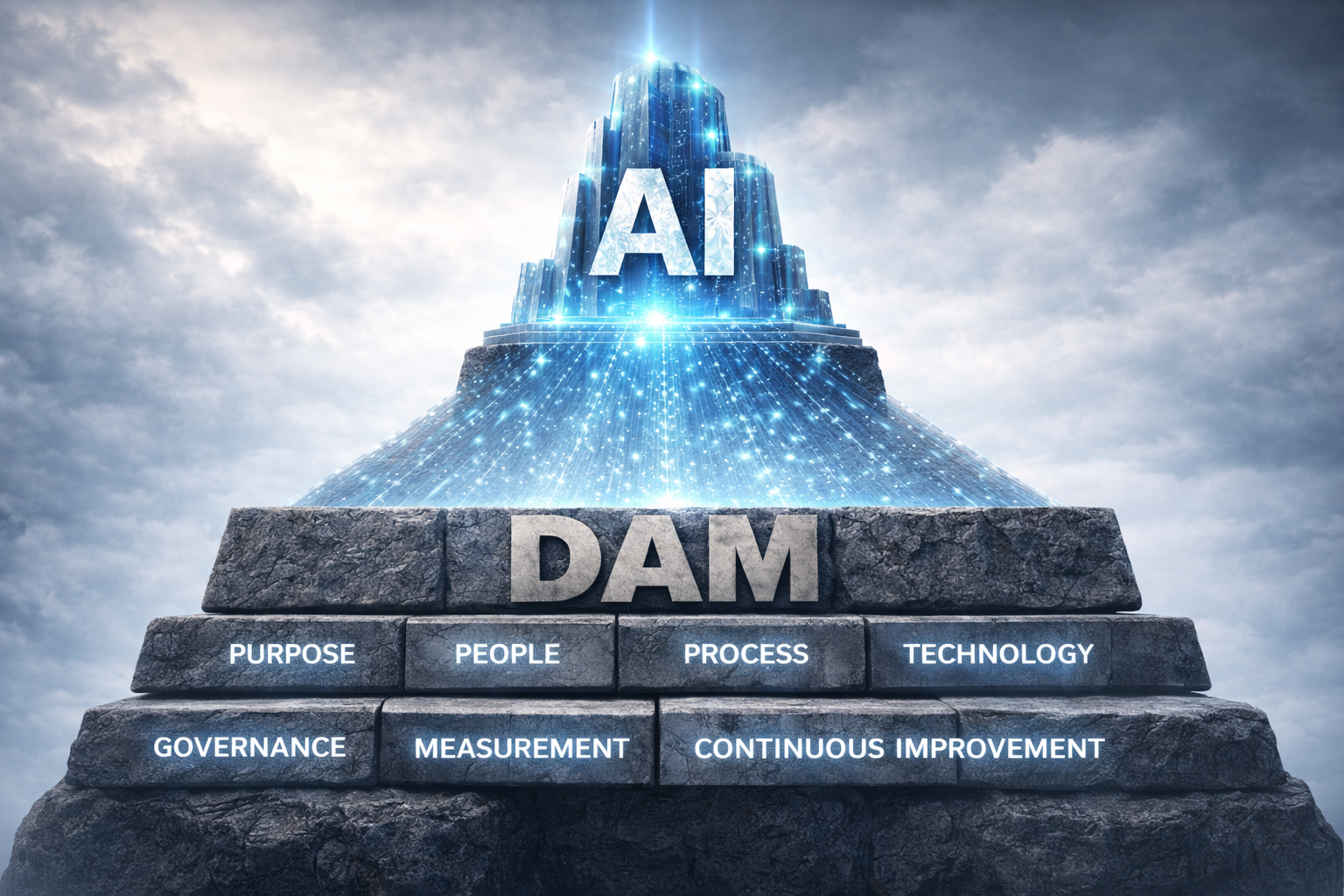
Without it, AI becomes another layer of activity on top of instability, rather than a multiplier of value.
This includes things like:
- A metadata model and taxonomy aligned to how the business finds, governs, and uses content
- Clear governance, ownership, and operating mechanisms that sustain quality over time
- Permissions, rights management, and policy controls that protect the organization as discoverability improves
- Workflows and practices that scale across teams and regions
- Integrations that support end-to-end operations, not isolated repositories
When these fundamentals are in place, the outcomes leaders are looking for become achievable:
- AI works as intended
- Automation becomes reliable
- Rights and intellectual property are protected
- Workflows scale and cycle times drop
- Adoption increases because teams trust the system
- ROI becomes visible and defensible
If your organization is under pressure to move faster with AI, the highest-leverage move is to treat DAM fundamentals as an executive-level capability, not an operational nice-to-have.
That framing also gives DAM practitioners the language they need internally: the work is not “cleanup.” It is risk mitigation, preparedness, efficiency enablement, and value realization. The goal is not to slow down AI. The goal is to make AI safe and effective.
AVP helps organizations close the DAM AI Gap by building the foundation required to make AI safe, scalable, and ROI-driving. We provide the expertise and capacity to:
- Build or rebuild taxonomy and metadata structures
- Establish governance, permissions, and rights management
- Fix workflow and operational bottlenecks
- Stabilize underperforming DAM environments
- Support lean or capacity-constrained teams
- Integrate AI safely and effectively
If you are not seeing the results you expected from DAM or early AI initiatives, start with readiness. Close the foundational gaps that determine whether AI becomes a multiplier or a liability.
Work with AVP to build the DAM foundation that enables safe deployment, scalable operations, and defensible ROI.
DAM delivers on the promise of AI. AVP delivers on the promise of DAM.
Let us know how we can help you.
Trust, Authenticity & Governance for the AI Age
1 December 2025
Trust is hard to come by.
Eminem
Technology succeeds when it is leveraged to transform data into information and then information into insight that can then generate action and meaning. Collective actions build mutual trust among community members, establishing knowledge-sharing opportunities, lowering transaction costs, resolving conflicts, and creating greater coherence. Trust sets expectations for positive future interactions and encourages participation with technology. Communicating the meaning and purpose of why a technology tool is being used will build trust with its audience and impact positive experiences. Trust in technology and the data flowing through all connected systems will lead to greater participation that will increase information’s value and utility. But is artificial intelligence (AI) in our content, our documentation, and our marketing information is making this all the messier and more complicated? The question is, do we trust what we see and read?
AI as an energetic force for change in our modern business content systems such as a DAM, PIM, CMS, and e-Commerce will accelerate the conversation between business and consumer. All the integration and interconnectivity between business applications strengthens the argument for strong and authoritative metadata, and for effective workflow management. Businesses creating and disseminating brand and marketing messages and products will engage with the consumer community who will respond with shopping behavior, internet searches, assets, and data such as reviews, comments, images, check-ins and other online actions. Data serving content as a connection between people, process, and technology.
Furthermore, understanding the needs of users and showing transparency in the technology, the people and the process will improve the experience and start the path to building trust. And yet, trust is hard to come by because there is not enough of it in our data. It’s no surprise that some of the biggest and most vocal critics of AI are artists themselves, the creators, those who create from an original and inspired source.
“I hate AI … AI is the world’s most expensive and energy-intensive plagiarism machine. I think they’re selling a bag of vapor.” – Vince Gilligan
“People ask if I’m worried about artificial intelligence, I say I’m worried about natural stupidity?” – Guillermo del Toro
And we are beginning to see more criticism from the creative community of AI being used in marketing the most recent of which is the negative feedback on Coca-Cola’s 2025 Christmas ad which follows criticism of their 2024 efforts. This in tandem with the persistence of “AI hallucinations” gives us all reason to pause and query where the trust and authenticity is in our content. Should consumers be skeptical … yes, but if we start to “distrust” what we see, then uncertainty creeps into the relationship. A 2024 study by Bynder found that when posts sound AI-written, 25% of people think the brand feels impersonal, and others flat-out call it lazy. Trust is getting harder to come by in a world filled more with hyperbole than facts, precision and nuance.
Let’s get some definitions out of the way to help both ground and illuminate this discussion:
Authenticity – The trustworthiness of a record as a record, i.e., the quality of a record that is what it purports to be and that is free from tampering or corruption.
Provenance – The origin or source of something. Information regarding the origins, custody, and ownership of an item or collection.
Integrity – The quality of being honest and having strong moral principles; of being whole and complete.
Data Integrity – The property that data has not been altered in an unauthorized manner; in storage, during processing, and while in transit.
What’s your data-driven AI strategy? We want the data and the machines managing it to learn and do more, but we must provide them with good, quality data for them to do that. Good data = smart data = good learning = happy customers. But if the data delivered does not match the user expectations, then the efficiencies of a personalized, and meaningful consumer experience are lost. Do we trust what we see and read? Data is the foundation for all that organizations do in business and how they interact with their customers. Data is proliferating, and that growth is only going to continue exponentially. As it multiplies, organizations need refreshed, enterprise-level approaches to systematically create, distribute, and manage data for your brand and your customers. Is authentic, accurate, and authoritative data the foundation to help us navigate the digital age?
Information Integrity
“Transparency builds trust.”
Denise Morrison
Data provides the link allowing processes and technology to be optimized. But if the data delivered does not match the user expectations of accuracy and authenticity, trust may be lost. Trust may not always be built with consistency if the facts are not always there. Be mindful of the current situation and the challenges faced. More importantly, be mindful of the people, processes, and technologies that may influence transformation. Information, IP and content are critical to business operations; they need to be managed at all points of a digital life cycle. Trust and certainty that data is accurate and usable is critical. Leveraging meaningful metadata in contextualizing, categorizing and accounting for data provides the best chance for its return on investment. The digital experience for users will be defined by their ability to identify, discover, and experience an organization’s brand just as the organization has intended.
Integrity of information means it can be trusted as authentic and current. When content is allowed to move freely, the chain of custody can be lost, undermining trust that the information is original. By establishing rules around originality and custodianship, or document ownership, content can be relied on as the “single source of truth,” and there may well be more than one source of truth, for it is authenticity we seek. As an example, if we define content as something that has value to the organization, then controls should be placed on access to that content. If controls are not in place, or they are insufficient, then the consequences can be embarrassing and costly. Possible dangers might include having the company sustain damage to its reputation, or it could result in the loss of trust of clients or consumers.
History teaches us that the study of “Diplomatics” in Archival Studies, posits that a document is authentic when it is what it claims to be. The Society of American Archivists (SAA) definition reads, “The study of the creation, form, and transmission of records, and their relationship to the facts represented in them and to their creator, in order to identify, evaluate, and communicate their nature and authenticity.” And, with that definition comes arguably its greatest modern proponent of Diplomatics, Luciana Duranti, reminds us to be mindful of, “the persons, the concepts of function, competence, and responsibility” must all be considered when considering digital assets and trust, from creation to distribution. Trust in content created with authority, authenticity, and responsibility.
Governance is No Longer an Option
Governance is the process that holds your organization’s data operations together as you seek to become truly data-driven, realize the full value of your data and content, and avoid costly missteps. To be effective, governance must be considered as a holistic corporate objective establishing policies, procedures, and training for the management of data across the organization and at all levels. Without governance, opportunities to leverage enterprise data and ultimately your content to respond to new opportunities may be lost. By developing a project charter, working committee, and timelines, governance becomes an ongoing practice to deliver ROI, innovation, and sustained success. While technology is important, culture will prevail, for Governance is more than just “change management”. Governance demands a cultural presence and footprint. The best way to plan for change is to apply an effective layer of governance to your program.
In his autobiography, Permanent Record, Edward Snowden argues that “Technology doesn’t have a Hippocratic oath. So many decisions that have been made by technologists in academia, industry, the military, and government since at least the Industrial Revolution have been made based on ‘can we,’ not ‘should we.” Another example of governance is needed is reflected in the advice of moving away from the brash work ethic of “move fast and break things,” from millennial technobrat and Cambridge Analytica whistleblower Christopher Wylie, who argues for a “building code for the internet” and a “code of ethics”—in essence, regulations to prevent the technological atrocities of the past. Governance is about the ability to enable strategic alignment, to facilitate change, and maintain structure amidst the perceived chaos.
Good governance delivers innovation and sustained success by building collaborative opportunities and participation from all levels of the organization. The more success you have in getting executives involved in the big decisions, keeping them talking about AI making this a regular, operational discussion (not just for project approval or yearly budget reviews), the greater the benefits your organization will have. Participation from all levels of the organization is key. Engaging the leadership by involving them in the big decisions, holding regular reviews and keeping them talking about DAM or any content management system, will yield the greatest benefits.
Opportunities to Provide Authenticity
From a legal point of view, there is some hope for the future as new legislation regarding AI creation and usage does take into account issues of “transparency” and “provenance,” most notably in the new California Transparency Act (AB 853) (SB 942), and the Transparency in Frontier Artificial Intelligence Act (TFAIA) all coming into effect in 2026, with the EU Artificial Intelligence Act been in place since 2024.
From a practical point of view, there are some things we as digital creators and managers of content may do:
- C2PA, Coalition for Content Provenance and Authenticity, provides an open technical standard for publishers, creators and consumers to establish the origin and edits of digital content at the metadata level. This also includes Content Credentials to leave a metadata audit trail for your digital assets (e.g. date, time, and location of creation, along with a digital signature to prove authenticity)
- Employ embedded digital signatures and watermarking.
- Implement AI detection to identify if an image, video, or audio file has been altered or generated by AI.
- Quality control and data verification on a regular basis throughout the digital asset life cycle to ensure content came from trusted and authorized sources.
- Governance as an organizational process to mitigate risk and to achieve your goals.
Amidst the clash and clatter of AI it is good to know there are real tangible things you can start doing to use people, process, technology and data to navigate this complex environment.
Conclusion
Good, trusted, authentic data is critical to AI; trust and certainty that the data is accurate and usable is critical for success. And be mindful of the people, processes, and technologies that may influence data and learning within business. Data will only continue to grow. There has never been a more important time to make data a priority and to have a road map for delivering value from it. AI provides great opportunities for communication, engagement, and risk management. Data sharing and collaboration will play an important part in growth, as business rules and policies will govern the ability to collect and analyze internal and external data. More importantly, business rules will govern an organization’s ability to generate knowledge—and ultimately value. To deliver on its promise, data must be delivered consistently, with standard definitions, and organizations must have the ability to reconcile data models from different systems.
A call to action … may we all just slow down. Simple, and effective. Yes, AI is incredible and powerful and advancing at a fast pace, which is exactly why we need to slow down as best as we can. Remember to evaluate your trusted sources of information and evaluate what you are reading. Trust may not always be built with consistency if the facts are not always there. Be mindful of the current situation and the challenges faced. More importantly, be mindful of the people, processes, and technologies that may influence transformation. Information, IP and content are critical to business operations; they need to be managed at all points of a digital life cycle. Trust and certainty that data is accurate and usable is critical. Leveraging meaningful metadata in contextualizing, categorizing and accounting for data provides the best chance for its return on investment. The digital experience for users will be defined by their ability to identify, discover, and experience an organization’s brand just as the organization has intended.
While metadata may help us find the facts needed for that truth, governance is the structure around how organizations manage content creation, use, and distribution and a critical part to developing trust. Ultimately, governance is the structure enabling content stewardship, beginning with metadata and workflow strategy, policy development, and more, and technology solutions to serve the creation, use, and distribution of content. Content does not emerge fully formed into the world. It is products of people working with technology in the execution of a process… the transparency needed for content to be authoritative, authentic, and all willing, responsible. Trust may be built through transparency and quality data, and trust may be earned through good governance; your brand depends upon it.
Citations
- https://variety.com/2025/tv/news/pluribus-explained-vince-gilligan-rhea-seehorn-1236571666
- https://www.hollywoodreporter.com/movies/movie-news/guillermo-del-toro-not-worried-artificial-intelligence-1235585785/
- https://www.creativebloq.com/design/advertising/what-brands-can-learn-from-coca-colas-terrible-ai-christmas-ad
- https://www.bynder.com/en/press-media/ai-vs-human-made-content-study/
- https://interparestrustai.org/terminology/term/authenticity
- https://dictionary.archivists.org/entry/provenance.html
- https://dictionary.cambridge.org/us/dictionary/english/integrity
- https://csrc.nist.gov/glossary/term/data_integrity
- https://calmatters.digitaldemocracy.org/bills/ca_202520260ab853
- https://calmatters.digitaldemocracy.org/bills/ca_202320240sb942
- https://www.gov.ca.gov/2025/09/29/governor-newsom-signs-sb-53-advancing-californias-world-leading-artificial-intelligence-industry/
- https://artificialintelligenceact.eu/
Choosing a DAM System: A 10-Point Framework for the Final Decision
27 August 2025
After months of evaluating platforms, the moment has arrived: it’s time to make a decision on your digital asset management (DAM) system. Your choice will shape how your teams access, manage, and use content for years. Our goal is to help you move forward with confidence.
We assume you’ve already done the necessary legwork: aligning stakeholders, identifying requirements, evaluating right-fit vendors, and running demos and a POC tailored to your assets and workflows. If not, consider revisiting those steps—take a look at our previous posts in this series.
Reconnect with Your Digital Asset Management System Goals
Before comparing feature lists or pricing tables, revisit why you began this process. What problems are you trying to solve? What does success look like a year from now? Make sure your final decision is rooted in those goals. Your task is to choose the digital asset management system that best supports your organization, not just the one with the flashiest interface.
Evaluate DAM Vendors Using a Structured Framework
A decision of this magnitude benefits from objectivity. Using a structured scoring model or decision matrix can help your team make a transparent, evidence-based selection. This approach allows you to evaluate each platform against consistent criteria, assign weights based on your priorities, and compare options side by side. It also creates documentation that supports internal alignment and future reference.
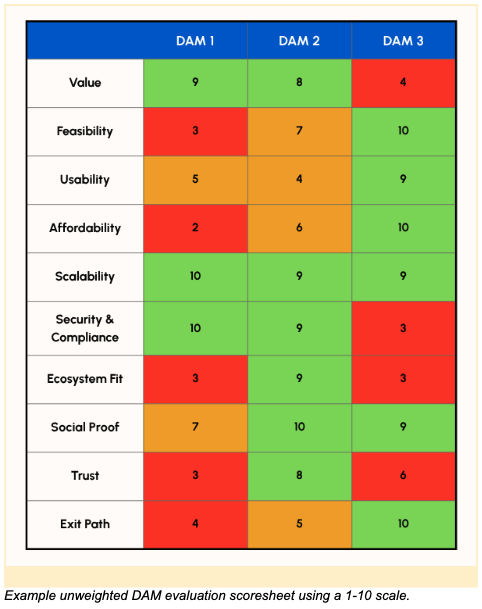
Ten Dimensions to Evaluate Each Digital Asset Management System Vendor Finalist:
1. Value
Does the platform deliver the functionality you need? Does it offer capabilities that significantly improve how your organization produces, manages, and shares content? Focus on alignment with your current and future needs, not the total number of features.
2. Feasibility
Can you implement and maintain the platform with your available resources? Consider implementation effort, integration complexity, and ongoing management. A great-looking system may require infrastructure or capacity you don’t currently have.
3. Usability
How easy is the system for different user groups—admins, content creators, and end users? If these groups weren’t included in demos, or didn’t participate in a proof of concept, go back a step. Be sure to get input from the people who will be affected most. Don’t forget to test admin functionality too.
4. Affordability
Is the pricing model sustainable? In addition to license fees, consider implementation (including integration and migration), training, support, storage, and feature add-ons. Don’t forget to look at the cost of utilizing AI services, too. We recommend projecting costs over at least three years to get a clear picture of the price.
5. Scalability
Will the platform grow with you? Think about asset volume, metadata complexity, user numbers, and geographic spread. If you have a particularly large collection or number of users, ask the vendors what their largest deployments are. Review whether the vendor’s roadmap aligns with your growth trajectory.
6. Security & Compliance
Does the platform meet your organization’s security and compliance requirements? Evaluate encryption, access controls, audit trails, and alignment with standards like GDPR or SOC 2. Consider both technical and policy aspects.
7. Ecosystem Fit
How well does the platform integrate with your current systems? Assess APIs, connectors, plugin availability, and the vendor’s experience with relevant third-party tools. Custom integration can quickly become a significant area of cost and complexity, so look for vendors that plug-in to your ecosystem easily.
8. Social Proof
Have similar organizations (in industry, size, scale, complexity) adopted this platform successfully? Are they growing with it over time? Review case studies, references, and testimonials. Speak directly with current customers to learn about the vendor’s strengths and limitations.
9. Trust
Does the vendor seem like a reliable long-term partner? Look at financial stability, delivery track record, and support reputation. Review SLAs, support channels, and upgrade policies. You’ll get great insights when you speak to other customers.
10. Exit Path
If your needs change, can you move on easily? Ask vendors how they support full export of assets, metadata, vocabularies, and user data in open formats. Understand the terms and costs of a potential exit.
Assign Weights and Score Objectively
Not all criteria carry the same weight. A nonprofit with limited IT support may prioritize feasibility and security, while a global brand may focus on integration and scalability. Assign weights to reflect your priorities, then score each option accordingly.
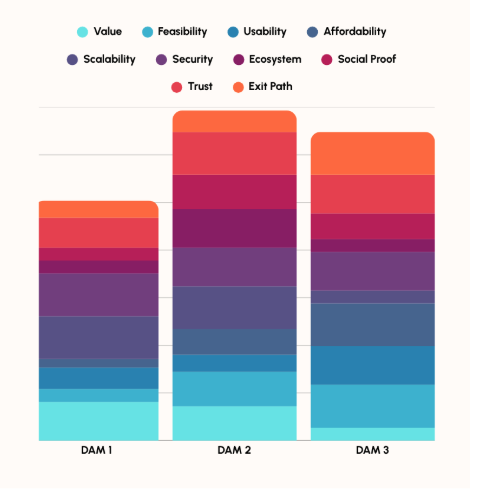
Final DAM evaluation using weighted scoring
Include a cross-functional team in the process to reflect diverse perspectives and build alignment. Document your evaluation so you can refer back to it as needed.
Avoid Common Final-Decision Pitfalls
Even with a strong evaluation process, watch out for these missteps:
- Letting brand recognition or peer adoption sway your decision
- Letting cost outweigh actual needs
- Underestimating implementation, integration, and migration effort
- Failing to thoroughly vet vendor support and services
Get Internal Buy-In and Document the Decision
Before finalizing, make sure all key stakeholders are aligned. Review the decision rationale with leadership, legal, procurement, and IT to surface any final concerns. And as a reminder, don’t forget to talk to your chosen vendor’s current customers (and not just the ones they suggest you talk to!)
Document your decision, including priorities and tradeoffs. This record will be valuable during implementation and future reviews.
Final Thoughts
Selecting a DAM system is more than a software purchase. It’s a strategic decision that will shape how your organization manages content for years. Use comprehensive evaluation criteria and a collaborative process to choose with confidence.
When implementation begins, you’ll be glad you did.
Digital Asset Management Demos and Proof of Concepts
27 August 2025
Digital asset management demos and POCs are where things get real. A demo is a live, guided walkthrough of your specific usage scenarios—ideally using your actual assets. A proof of concept (POC) goes further, giving your team hands-on access to test how the system performs with real workflows. Together, they offer a grounded, honest look at whether a system fits, not just how it looks in a sales deck.
A structured, goal-driven approach to managing these activities is the best way to move from feature lists to informed decisions.
Before the Demo: Set Your Foundation
Start by defining what matters most to your organization. Common areas to evaluate in a DAM system include:
- Workflow automation
- Metadata structure and taxonomy
- Permissions and user roles
- Search and discovery
- Upload and download processes
- User interface and experience (UI/UX)
- Integrations with other systems (e.g., CMS, PIM, MAM)
Also consider what makes your organization unique. Do you manage large volumes of high-resolution images, video, or audio (rich media)? Do you need to preserve or migrate older, inconsistent, or incomplete metadata (often referred to as legacy metadata)? These factors should inform the usage scenarios you ask vendors to demonstrate or support during a proof of concept (POC).
If you haven’t created usage scenarios yet, now’s the time. A usage scenario is a short, structured description of a key task a user needs to perform in the system. Each should include:
- A clear title
- The goal or objective
- The user role
- A brief narrative of the scenario
- Success criteria
Aim for 6 to 8 scenarios that reflect your core needs across different user types. A focused set like this keeps digital asset management demos and POCs grounded in what really matters to your team and ensures a more meaningful evaluation.
Preparing for the Demo
Give vendors a chance to show how their system handles your real-world needs. Ask them to walk through 4–5 key tasks your users need to perform in a two-hour demo session.
About two weeks before the demo, send each vendor a small sample of your actual content—around 25 assets in a mix of file types and sizes—along with a simple spreadsheet describing those files (titles, descriptions, dates, etc.). If you work with items made up of multiple files (like a book with individual page scans), include one or two of those as well.
The goal is to see how the system performs with your materials—not polished demo content—so you can better understand how it might work for your team.
Digital Asset Management Demo Participation and Structure
Invite a diverse group:
- Core users
- Edge users with atypical needs
- Technical staff
- Decision-makers
Suggested agenda:
- 30 minutes – Slide-based intro and vendor context
- 60 minutes – Live walkthrough of your usage scenarios
- 30 minutes – Open Q&A
Distribute a feedback form before the demo so your teams can rate the system and each usage scenario in real time. Collect quantitative scores (e.g., “On a scale of 1–5, how well did the system support this scenario?”) to make it easier to compare vendors side by side. Include a few qualitative prompts as well, such as “What surprised you?” or “What did you like or find confusing?” Keep the form short and focused—if it’s too long, people won’t fill it out.
Running the POC
Once you’ve identified a finalist, it’s time for hands-on testing. A two-week POC is ideal—short enough to keep momentum, long enough to explore.
Set expectations upfront. Testers must dedicate focused time. The POC isn’t a background task. If people delay or casually click around, you won’t get meaningful results.
Check with the vendor about potential POC costs. Some vendors charge if their team invests heavily and you don’t purchase. Ask early.
Prepare for a successful POC:
- Give vendors ~3 weeks to configure the system with your content and workflows. Share usage scenarios and access needs early.
- Assign clear roles, for example:
- End Users – Test search, discovery, and downloads
- Creators – Test uploads, tagging, and editing metadata
- Admins – Test permissions, structure, workflows, and configuration
- Create a task-based script aligned with your usage scenarios. Ask testers to log their experience, pain points, and surprises.
- Schedule three vendor touchpoints:
- Kickoff (60 min): Introduce the vendor, ensure everyone has access, clarify roles, and walk through the POC goals and script.
- Midpoint Check-in (30 min): Surface blockers or confusion while there’s still time to fix them. Encourage open questions: “How do I…?” or “Why isn’t this working?”
- Wrap-up (30 min): Review what worked and what didn’t. Ask the vendor to walk through anything missed. Preview post-purchase support and onboarding to help gauge confidence in next steps.
Reminder: This is not a sandbox. Stick to the script, test with intention, and focus on how the system performs in a real working scenario.
Decision Making
Pull your team together while the experience is still fresh.
Start with the structured feedback:
- Compare rubric scores across categories like usability, metadata, permissions, and admin tools.
- Look for patterns or outliers: did some roles struggle more than others?
- Discuss gaps, friction points, and what’s non-negotiable.
If your group is large, collect final thoughts via a form and summarize for review.
Document your decision—not just which system you chose, but why. Connect it to your business goals, priorities, and user needs. This not only strengthens your recommendation, but also provides valuable context for onboarding new users and teams. When people understand the reasons behind the choice, they’re more likely to engage with the system and use it effectively. It also gives you a foundation for measuring success after launch.
Final Thoughts
Digital asset management demos and POCs don’t just validate vendor claims, they clarify your priorities, surface assumptions, and test how ready your team is for change. They help you figure out not just if a system works, but how it works for you.
A well-run process builds alignment, fosters engagement, and reduces risk by exposing critical gaps early. Most importantly, it sets the stage for a smoother implementation.
When you choose a system based on real tasks, real users, and real feedback, you’re not just buying software. You’re investing with confidence.
Conducting Market Research and Shortlisting Digital Asset Management Vendors
27 August 2025
Choosing a Digital Asset Management (DAM) system is one of the most critical decisions an organization can make for managing digital content. But diving into the DAM market without guidance can be overwhelming. Dozens of vendors offer similar feature sets, and without a clear plan, it’s easy to get lost in marketing jargon or swayed by a sleek demo that doesn’t reflect your real-world needs.
This process isn’t just about picking a product. It’s about starting a long-term relationship with a vendor who will support your team, evolve with your workflows, and play a role in your digital strategy. That’s why thoughtful market research and intentional shortlisting are essential.
Begin with Requirements, Not Features
Effective vendor research starts with clarity about your needs. Before browsing solutions, define what your organization actually requires from a DAM platform. Consider:
- Who your primary users are and what they need to do with assets
- What types of assets you manage (images, video, audio, documents)
- Metadata standards and requirements
- Integration needs (CMS, PLM, PIM, creative tools, cloud storage, preservation)
- Permission models and access control
- Reporting, analytics, and training needs
List “must-have” and “nice-to-have” features, then use that as your rubric. This helps you stay focused on what matters and avoid shiny features that don’t advance your goals.
Navigating the Digital Asset Management Marketplace
A web search is a fine place to start, but it’s not enough. Vendor websites offer a polished view, but few provide meaningful detail about true differentiators, limitations, or ideal usage scenarios.
Sites like G2, Trustpilot, and Capterra offer user-generated reviews and side-by-side comparisons, which can be helpful for spotting trends or potential red flags. That said, be aware that many listings are paid placements, and reviews often lean toward the extremes—either very positive or very negative. Also, many of the tools listed on these sites aren’t actually full-featured DAM systems. Some, like Canva or Airtable, offer DAM-like features but may not meet the broader needs of your organization. This can make it tricky to distinguish between tools that support part of the workflow and those that can truly serve as a centralized DAM solution.
For deeper and more balanced insight, explore:
- DAM News – Offers industry-specific news, vendor updates, and interviews with practitioners.
- CMSWire – Covers a range of digital workplace topics, including strong, up-to-date content on DAM.
- LinkedIn – A powerful resource where DAM professionals share real-world insights, lessons learned, and vendor experiences. Connect with industry peers who have already implemented a DAM and ask for honest feedback and recommendations.
Research Firms & Case Studies
- Reports from Gartner, Forrester, and Real Story Group provide in-depth vendor evaluations and market analysis. (You can typically find these linked from vendor websites.)
- Seek out case studies from vendor websites to understand how specific solutions perform in real-world contexts.
Industry Events
Consider attending a Henry Stewart DAM Conference, which gathers DAM professionals and vendors for learning and networking. These take place annually in:
- London (June)
- New York City (October)
- Sydney (November)
- Los Angeles (March)
These events offer an opportunity to demo different systems and meet digital asset management vendors in person, expert panels, and the opportunity to hear directly from other organizations about their selection and implementation journeys.
Learn from Peers, with Context
Colleagues can be a great source of insight. Ask what systems they use, what worked well or poorly, and what they’d do differently. These conversations reveal how vendors behave during implementation and long-term support.
But keep in mind: a DAM that works well for your pal over at their organization may not be right for you. Your users, workflows, and digital strategy are unique. A negative experience elsewhere might reflect poor alignment rather than a flawed system. Treat peer feedback as helpful context, not universal truth.
Consult the Experts
If you lack time or in-house expertise, consider hiring a DAM consultant. Specialists know the landscape, can translate your needs into actionable requirements, and can help you run a disciplined selection process. They can also facilitate internal conversations neutrally to surface user needs and pain points, ensuring decisions are informed by real requirements and aligned with strategic goals.
Digging into DAM Differentiators
Most DAMs claim to offer robust features—AI, metadata support, flexible permissions, and more. These terms sound impressive, but they rarely reveal how the system actually works in practice. Real differentiators are found in the details across all functionality areas.
For example:
- “AI” alone isn’t helpful. One platform might offer basic auto-tagging, another facial recognition, or full generative AI descriptions and AI-driven workflows tied to metadata.
- “Controlled vocabularies” are standard. A system with the ability to support complex taxonomies, multilingual thesauri, or ontology integration might stand out if this is what your organization need.
- “Permissions” are expected. Granular controls, field-level restrictions, and automated rights management are worth noting.
Ask vendors for documentation that shows actual configuration options, not just marketing overviews. In demos, go beyond checklists. Ask how it performs at scale, supports your asset types, and adapts to real-world workflows. If you don’t push, vendors may not volunteer specifics.
Engage Digital Asset Management Vendors with Purpose
Once you reach out to digital asset management vendors, you’re signaling interest. Sales reps will follow up. That’s expected. Many will work hard to win your business, and that can be a good thing. But this isn’t just a sales transaction. If you choose their system, you’ll likely be working closely with that company for years.
Pay attention to how vendors engage with you. Do they ask thoughtful questions about your needs? Offer strategic guidance? Or are they focused only on closing the deal? You want a partner, not just a product.
Ask tough, specific questions. Request use-case examples. Involve your users early so they can determine if the system fits their actual workflows.
Early demos can help you understand layout and navigation. But once you’re seriously considering a system, ask for tailored demonstrations using your scenarios and assets. This helps you evaluate both product fit and vendor fit—their responsiveness, flexibility, and support philosophy. And if you really want to get under the hood, consider doing a proof of concept with your top 1-2 finalist vendors.
Building the Shortlist
A shortlist should include only those digital asset management vendors who align with your requirements, fall within your budget, and seem like a cultural fit. Aim for five to six vendors for your Request for Information (RFI) or Request for Proposal (RFP).
After reviewing the vendors’ responses, narrow the list to two or three finalists. Invite them for detailed demos, reference calls, and technical Q&A. Note that at this point, you’re evaluating the partnership as much as the platform.
What Makes Digital Asset Management Vendors Shortlist-Worthy
A vendor becomes shortlist-worthy not just by meeting your technical and functional requirements, but by demonstrating alignment with your organization’s broader context and strategic direction. Beyond feature fit, consider factors like company size and funding stability—these can indicate whether a vendor is likely to support and evolve their platform over the long term. Geographic location may matter for support hours, data residency, or language requirements. Longevity and client retention can signal maturity and reliability, but don’t discount newer vendors if they show strong responsiveness and innovation. Experience within your industry or with similar organizations can also be a valuable indicator of how well the vendor understands your needs and challenges. Most importantly, assess cultural and strategic fit: does the vendor listen actively, offer thoughtful insights, and seem invested in your success? A good partner should feel like an extension of your team, not just a service provider.
Final Thoughts
DAM market research is both a filtering and discovery process. It takes effort, but the payoff is a well-aligned solution that fits your organization and your future.
Stay focused on your goals. Be curious, but critical. Ask hard questions. A solid selection process sets you up for long-term success—not just with the tool, but with the vendor team that supports it and the users who rely on it every day.
Assessing Your Organization’s Digital Asset Management Needs
27 August 2025
Choosing a Digital Asset Management (DAM) system is a high-stakes process, but it can also be energizing and collaborative when done right. Whether you’re replacing a legacy system or starting from scratch, the first step is understanding what people need. This means listening carefully, mapping what’s working and what’s not, and building shared enthusiasm for what a DAM can unlock.
Start with People
The foundation of this work is people. Find them, talk with them, and the rest will start to fall into place. Before you dive into features or vendors, start with people. A DAM system’s success depends on the constituency that uses and supports it, so identifying and engaging the right voices is essential.
Who makes or uses the digital assets?
Think broadly about anyone who creates, manages, approves, uses, or delivers digital assets. That might include:
- Content creators, designers, and editors
- Marketing and communications teams
- Archivists and records managers
- Product or project managers
- IT and security staff
- Legal, compliance, and risk officers
- Executive sponsors and decision-makers
- Funders or departments responsible for system costs
To identify the right stakeholders, ask:
- Who touches assets from creation through to delivery and preservation?
- Who makes decisions about DAM staffing, training, and long-term support?
- How is the DAM currently funded—or how will it be funded in the future?
Start broad. As you engage people across roles and departments, a smaller group will naturally emerge with deeper involvement, insight, and decision-making responsibility. These are your core stakeholders—the people who will help shape the system and carry it forward.
Listen for Insights
Stakeholder input isn’t just helpful—it’s essential. These conversations shape your goals, expose pain points, and clarify what your DAM needs to support. Engaging the right people early gives you a clearer view of how assets are really managed—and where the friction lives.
As you talk with them, don’t just focus on workflows. Ask about long-term support: Who will own the DAM? Is IT prepared to manage integrations, infrastructure, and security? Is there funding or staffing available to maintain governance, training, and standards? These questions are just as important as functional needs and should guide your assessment from the start.
Start with short, focused interviews. Skip surveys, which often yield surface-level feedback. Instead, speak one-on-one or in small groups. Record conversations (with permission) so you can revisit the details. Ask open-ended, practical questions like:
- What tools do you use to create, manage, or find digital assets?
- What do you wish were easier?
- What already works well?
- How do you handle rights or metadata?
- What slows you down or creates confusion?
- If you had a magic wand, what functionality would you ask for?
Pay attention to the language people use. It’s invaluable when you begin writing requirements or explaining priorities to vendors.
Organize and Prioritize What You’ve Learned
Once you’ve gathered enough feedback, use a simple rubric to organize and prioritize what you’ve learned. This helps you spot patterns, identify gaps, and guide planning. Assessment isn’t just a step toward a decision. It’s how you learn what success will require. It helps you see not only what’s broken but what’s working, what people hope for, and what you’ll need to prioritize.
Your assessment should help you answer:
- Where are the friction points in your asset lifecycle?
- What are the root causes of confusion, delays, or errors?
- What already works well and could be scaled?
- What would help your teams collaborate better or move faster?
A useful way to organize this thinking is with a simple rubric:
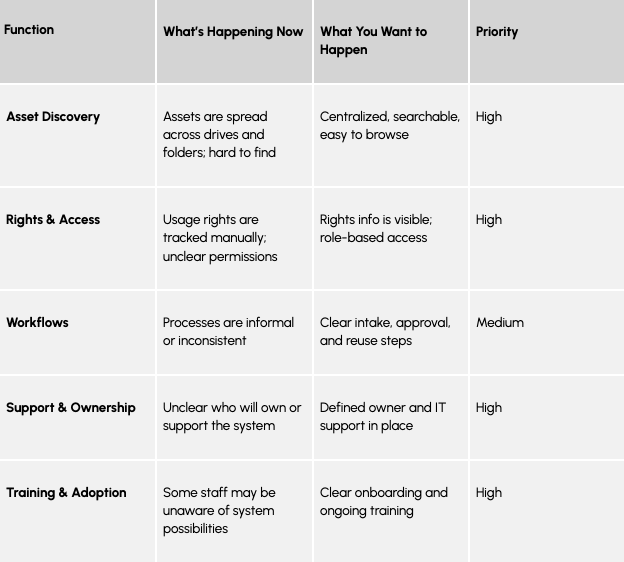
This high-level rubric helps turn qualitative insights into a shared understanding of your current landscape. It can surface high-impact gaps, clarify priorities, and serve as a foundation for your implementation roadmap or RFP.
Keep Listening, Keep Refining
At the heart of a successful DAM assessment are people—the users, decision-makers, and behind-the-scenes teams who rely on digital assets every day. Their insights are the source of your best ideas.
Information gathering isn’t a one-time process. Keep asking questions. Keep listening. As your understanding deepens, your priorities will evolve, and your system requirements will sharpen. The more inclusive and user-driven your approach, the more likely you are to select a DAM that meets your real needs and earns long-term support.
What may feel like a jumble of tools, frustrations, and hopes now will eventually turn into clear priorities, confident decisions, and, most importantly, a system that fits the way your organization actually works.
Focus the Vision for Your Digital Assets
With input from your stakeholders in hand, it’s time to define a shared vision for what the DAM is meant to accomplish. That vision comes to life through clear, outcome-driven business objectives. These objectives articulate the why behind the DAM: why it matters, what it will change, and how you’ll know it’s working.
Business objectives help you prioritize features, align teams, and communicate the system’s value to leadership. They keep the project focused, especially when you’re evaluating trade-offs or making decisions down the line.
Before diving into detailed requirements, ask: What does success look like with a digital asset management system in place? Are you aiming to reduce legal risk? Speed up campaign delivery? Preserve institutional knowledge? These goals shape every step of your selection and implementation process and are communicated through business objectives.
A strong business objective answers:
“What are we trying to improve, fix, or enable with this system?”
Sample Business Objectives:
- Reduce time spent searching for assets by 50% to support faster content delivery Teams currently spend significant time locating approved visuals and files. Reducing this friction will help meet tight publishing timelines and improve responsiveness.
- Ensure only licensed assets are used in public materials Inconsistent tracking of usage rights increases legal and reputational risk. A DAM should help enforce compliance and make rights information visible and actionable.
- Consolidate digital assets created by different users and stored in disparate systems Assets are currently spread across local drives, cloud folders, and legacy tools. Centralizing them will support discoverability, collaboration, and long-term access.
Whenever possible, tie business objectives to measurable outcomes. For example: “Reduce asset search time by 50%” or “Ensure 100% of publicly used assets have visible rights metadata.” These goals can help you evaluate vendors—and later, your DAM’s performance.
Is a New Digital Asset Management System Actually Needed?
One of the goals of a good assessment is clarity. Sometimes that clarity reveals that a new DAM isn’t the right next step. You might discover that your existing system could work with better training, governance, or configuration. Or you may find that the real issue isn’t the technology, but the lack of shared standards or ownership. That’s still progress. A thoughtful assessment can help you solve the right problems, whether or not that includes replacing your DAM.
Next Steps: From Insight to Action
Whether your assessment points to the need for a new DAM or uncovers ways to improve the one you already have, the outcome is the same: you now know what you didn’t know before. It’s time to turn that insight into a plan.
Start by organizing what you’ve learned into something clear and shareable. A spreadsheet, a shared doc, or whatever helps your team keep track of it all. Consolidate data and priorities in one place to prepare for internal planning, vendor conversations, or decision-making.
As you move toward system selection or renewal, take a beat to assess your organizational readiness:
- Who will own the DAM long-term?
- Is IT prepared to support infrastructure, integrations, and identity management?
- Do you have staff or governance in place to manage the operation of the system?
A successful digital asset management system depends on more than just features. It also needs committed people, long-term support, and a structure that can grow with your organization. As you talk with stakeholders and gather input, make sure to document what you’re learning—key themes, priorities, pain points, and goals. Documenting these early insights will help shape shared understanding and keep things grounded as you move into planning and decision-making.
