Elevate
The Missing Link in Digital Product Creation: Why Apparel Brands Need DAM
12 May 2026
A new jacket lands on your radar for the upcoming season. Design finished the 3D model weeks ago, it went through review, got approved, and moved into production. But now you need the asset for a lookbook, a buyer presentation, a wholesale sell-in deck, and nobody can tell you where the files actually are. The designer who built it has moved on to the next collection and their original intent has been lost. The shared drive has fourteen nested folders and no naming logic you can make sense of. By the time someone tracks down something usable, you’ve already missed one deadline and you’re about to miss another.
If that sounds familiar, you are not alone. These scenarios play out constantly across apparel companies, and they can be prevented..
As 3D digital product creation becomes more utilized in the apparel industry, one critical capability has failed to keep pace: the strategic management of those digital assets. Most companies are spending heavily on 3D design software and talent while simultaneously leaving their 3D assets in fragmented, unmanaged chaos. Network drives, generic cloud storage, ad hoc folder structures: that is the reality for the majority of brands operating in this space right now.
This gap is a real problem. But it is also a real opportunity for the brands willing to address it.
What is your 3D asset chaos actually costing you?
The Current State of 3D Asset Management
Despite growing investment in 3D design capabilities, purpose-built Digital Asset Management for 3D assets remains rare in the apparel industry. A recent Kalypso industry survey found that over 87% of respondents agree that both PLM and DAM are prerequisites for a successful DPC program, and yet most digital assets are still managed in local shared drives or SharePoint.
Even among companies that have DAM systems, many are using platforms primarily designed for marketing assets. These platforms often lack critical capabilities for handling the unique characteristics of complex 3D files: containers, multiple components, dependencies, texture maps, simulation files, 3D previews, or version relationships that most DAMs simply are not built to manage.
The result is significant untapped potential. Sophisticated 3D assets, created at considerable expense, remain siloed within specific teams or use cases rather than flowing across the organization to create maximum value. That is not a technology problem. It is a management problem.
There are at least five areas where an integrated 3D DAM can make a measurable difference.
Speed to Market
In fashion, being first matters. A unified 3D asset library gives design teams the building blocks they need to respond to trends faster. Standard pattern blocks, digital fabrics, and avatar models, all of it accessible and reusable from a single source of truth.
Industry data backs this up. Fashion companies implementing 3D DPC tools have achieved up to 50% faster time to market. The reason is straightforward: when designers can reuse and remix existing 3D components rather than starting from scratch, the concept-to-sample timeline compresses dramatically.
This only works when assets are actually findable and usable across the organization. That requires a DAM. Without one, even a company with a large library of 3D assets effectively has no library at all. It just has a pile of files that no one can locate.
Virtual Prototyping and Sample Reduction
Physical sampling is one of fashion’s most persistent cost centers. There are multiple sample rounds, international shipping, and material waste. It adds up quickly, both financially and environmentally.
3D virtual prototyping attacks this problem directly. Industry examples show that 50% or more reduction in physical samples is absolutely achievable. An Australian Fashion Council pilot found that replacing 30 physical samples with digital equivalents cut sampling costs by 50%, reduced sample lead time from 12 to 4 weeks, and saved 450 meters of textile. German apparel retailer Bonprix has achieved 50 to 100% sample reduction depending on product complexity, with simpler styles requiring no physical sample at all.
The math is compelling. But these gains depend on having a central repository where digital prototypes, materials, and trims are stored, organized, and accessible. When 3D assets are managed as valuable inventory rather than scattered across individual hard drives, the reliance on physical samples can drop dramatically.
Sustainability and On-Demand Production
One of the most significant structural problems in fashion is overproduction. An estimated 30% of clothing produced is never sold and ultimately discarded, representing wasted materials, energy, and carbon emissions at scale.
3D DAM creates the infrastructure to address this at its root. When high-quality 3D assets can be used to gauge consumer demand before manufacturing begins, brands can move toward a sell-before-make model: produce only what has been ordered, in the quantities actually needed. This practice is uncommon as of now, but it is slowly gaining traction.
Some brands are already piloting this approach, using digital product experiences to test which designs resonate before committing to bulk production. Replacing physical samples with digital ones during design can cut a brand’s carbon footprint at that stage by 30%. Eliminate overproduction on top of that, and the cumulative impact across reduced material use, eliminated sample shipping, and lower inventory waste can reach 50 to 70% or more in carbon reduction in optimized scenarios.
New Digital Revenue Streams
This is where things get more forward-looking, but the opportunity is real, and the market has already validated it.
A 3D asset can itself be a product: a virtual garment, a digital sneaker, etc.high-quality 3D asset does not have to exist only as a step toward a physical product.
To capitalize on this, companies need production-ready 3D assets that are managed, versioned, and distributable. The same asset used internally for design review can, with the right DAM infrastructure, be polished and pushed to consumer platforms, including gaming engines, AR apps, and virtual marketplaces. Without that infrastructure, digital product launches remain one-off efforts that are too slow and too expensive to scale.
The marginal cost of selling a digital product, once the 3D asset exists, is essentially zero: no factories, no inventory, no logistics.
Most apparel companies have not yet entered this space meaningfully. Early movers have an advantage.
Immersive Customer Experience
Online shoppers cannot touch, try on, or examine products from every angle. 3D and AR help close that gap, and the conversion data is striking.
Shopify research found that products featuring 3D and AR content see a 94% higher conversion rate compared to products without it. That is not a marginal improvement. It is nearly doubling the likelihood of purchase. The same research found a 40% decrease in returns when shoppers used 3D or AR to visualize products before buying.
The mechanism is simple. When customers can rotate a 3D model, zoom in on fabric texture, or virtually try on a garment, their confidence increases. What was uncertain becomes concrete.
Managing this at scale requires a DAM. Without one, deploying 3D experiences is a one-off effort per product, expensive and slow. With a DAM, the same 3D asset used internally for design can feed directly into AR applications, 3D product configurators, and e-commerce visualization tools. The asset is already there, already approved, already versioned.
What is your 3D asset chaos actually costing you?
Where to Start
The opportunity is clear. The barrier to entry is not technology. Both 3D tools and DAM systems exist and are mature. The barrier is organizational: treating 3D assets as strategic assets worthy of proper management, rather than as design files that live on someone’s hard drive.
Practically, that means a few things. It means establishing a dedicated DAM for 3D assets, capable of handling the complex file types and relationships involved in 3D work. It means creating libraries of standard components that design teams can reuse and build on. It means setting KPIs around sample reduction, time to market, and asset reuse, and then actually measuring against them.
It also means fostering collaboration across traditionally siloed teams. When a merchandiser can pull a 3D model from the DAM to create a marketing visualization, or a factory can receive an exact digital spec for on-demand production, you have a connected digital workflow that creates value at every stage of the process.
Most apparel companies are still in pilot mode, experimenting with 3D in pockets without the connective tissue of a managed asset infrastructure. That gap between potential and reality is exactly where the competitive opportunity lives.
The brands that move now, the ones that build the 3D asset libraries and the DAM systems to manage them, will be positioned to move faster, waste less, reach consumers more effectively, and explore revenue streams their competitors have not considered yet. The tools are available. The use cases are proven. The question is whether your organization is ready to treat its digital assets as the strategic resource they actually are.
How to Manage Your Digital Assets Better
1 April 2026
How to Manage Your Digital Assets Better
The question eventually comes up in every organization. Your boss slides a budget report across the table and asks: “We’ve spent a lot on this DAM. What are we getting for it?”
You know the system works. Assets are in there, people are using it—mostly—and the platform delivered what the vendor promised.
But metadata is inconsistent, teams still email files or share from Box instead of using the DAM properly, and no one can agree on who’s responsible for keeping metadata clean. You don’t have a clear dollar amount or KPI results to point to.
If you’re reading this, you’re probably already preparing for that conversation with your boss.
When a DAM underperforms, the platform is rarely the problem. Governance gaps let the system drift because no one can make decisions. Change management failures leave users untrained and frustrated. And without measurement, no one defined what success looked like, so no one can tell whether they’ve achieved it. Those KPIs don’t even exist.
Optimization is the work of making your DAM operate the way it was intended—closing the gap between a system that’s been implemented and one that’s actually performing.
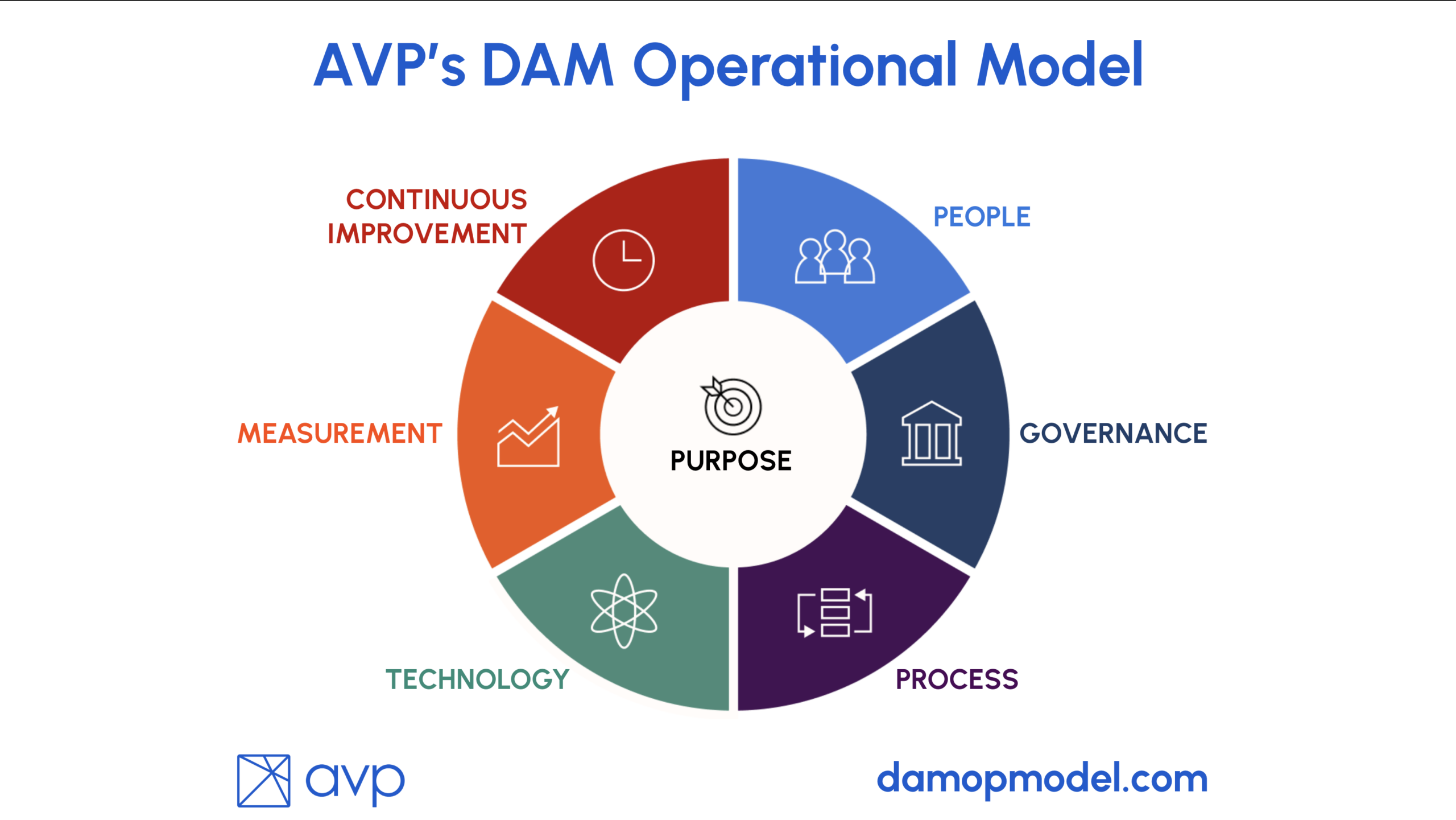
AVP’s Digital Asset Management Technical & Operational Framework is designed to help you do exactly that. It defines what a sustainable DAM program actually requires—not just technology, but everything that supports it.
The framework centers on Purpose, surrounded by six components: People, Governance, Process, Technology, Measurement, and Continuous Improvement. Together, they give you a structured way to identify where your DAM is falling short—and how to fix it.
It’s built on patterns we’ve seen across dozens of DAM programs. The problems are rarely mysterious. They tend to show up in the same places: governance that isn’t followed (or doesn’t exist), technology configured for the wrong users, and a lack of visibility into performance. The framework helps you address each of these in context.
How do I know my DAM needs help?
DAM problems don’t usually announce themselves—they accumulate slowly. A few inconsistent tags, an approval step everyone quietly skips, or a folder structure that stopped making sense two reorganizations ago. By the time users stop trusting the system, the issues have usually been building for a while.
The most common sign the DAM is failing is that people can’t find what they need.
If your users are asking colleagues where files live, storing their own copies locally, or recreating assets that already exist, your taxonomy and metadata aren’t doing what they should.
Low adoption is a close second, and one of the harder ones to diagnose. When people avoid the DAM, the instinct is to blame the interface or the platform. It’s almost never that, though. Unclear policies, inadequate training, and metadata quality are the more common culprits.
Then there’s the ownership question. Who decides what gets uploaded? Who approves assets before they go live? Archives content when it expires?
When no one has clear answers, things begin to fall apart. Files don’t get uploaded, permissions get messy, and the DAM stops being a source of truth users can trust.

And if someone asked you today what percentage of searches return a useful result, or which assets are actually being used, could you answer? Most teams can’t, and it’s one of the first things worth addressing.
Most DAM issues trace back to governance gaps, change management failures, and a lack of measurement—not the platform itself.
What you can do
When something goes wrong with a DAM, the first instinct is to blame the technology—a new platform, a better integration, or a different vendor. That instinct is understandable, but often wrong. AVP’s framework helps you step back and examine the full picture, not just the technology. In most organizations, the biggest issues lie in governance and people—the components that are hardest to see and easiest to overlook.
People
Most DAM programs are underleveraged because of limited staffing behind them.
Someone is managing the DAM on top of two other jobs, governance questions go unanswered because no one is clearly responsible, and onboarding new users falls to whoever has time. You’ll find that this gap will influence all others, and not in a good way.
Governance
Governance is usually where the real work is. Upload standards, naming conventions, roles and responsibilities, permission structures, archiving policies: most organizations have opinions about these things but haven’t written them down anywhere users can find them. (If your governance documentation lives in someone’s inbox, that counts.) When governance lives in one person’s head, it disappears when they leave. Document it, make it accessible, and revisit it whenever your organization experiences change.
Process
Having governance policies is one thing. Getting people to follow them is another. Process is where that gap lives. Map how assets actually move through your organization and look for where things break down: the step everyone skips, the handoff that falls through the cracks, the training that never happened. Change management belongs here too. When you’re asking people to work differently, telling them once and hoping for the best isn’t a plan.
Technology
Many DAM frustrations get blamed on the technology. In reality, a platform can only perform as well as the governance, training, and configuration behind it. If your taxonomy was built around internal assumptions instead of how users actually search, it will underperform on any platform. If features were never properly rolled out, the platform can look like the problem when the real gap is user training. Before you consider switching systems, make sure you understand why the current one isn’t working.
Measurement
This is how you answer your boss. Some of the KPIs that matter most for a DAM program and that will help when your boss asks:
- Search success rate (what percentage of searches return something the user actually uses),
- Asset utilization rate (which assets are being downloaded or shared versus sitting untouched),
- Active user rate (who is in the system and how often),
- Time to asset (how long it takes to find and retrieve what’s needed), and
- Metadata completeness (what percentage of assets have required fields filled).
Get baselines in place and track them over time, and then report them out.
Continuous Improvement
Once the foundation is solid, the work changes. It’s no longer about fixing things that are broken; it’s about keeping a working system humming as your organization evolves. That means building in recurring habits: a scheduled content audit, regular governance reviews, and a way for users to flag problems before they grow. Most organizations reach this stage gradually. The ones that see real success make maintenance routine rather than reactive.
When to bring in help
There’s a lot you can accomplish internally, and this framework gives you a strong place to start. But most DAM teams are already stretched thin (and often a “team” means “you”), and optimization work competes with everything else on the list. Without consistent attention, even well-built programs start to erode.
Outside support helps close that gap. An experienced partner can sit with your team, ask the questions that are hard to ask from the inside, and help you build something that lasts.
It often starts with an assessment to identify where things are breaking down, followed by the real work—incrementally solving those problems together.
The organizations that sustain a well-functioning DAM over time typically have that kind of support: someone who understands the platform and has seen what works elsewhere, and doesn’t have to start from scratch every time a problem comes up.
How you structure that support depends on where your program is. A focused project is a good place to start if the foundation needs work. Ongoing support makes more sense once things are running and you want to keep them that way. AVP can help with both.
Put the framework to work
The checklist on the following pages follows the same seven components: Purpose, People, Governance, Process, Technology, Measurement, and Continuous Improvement. Assign an owner and a due date to each item, work through it over a quarter, and revisit it once a year.
You won’t fix everything at once—and that’s fine. The organizations that end up with a DAM that actually works get there through steady progress, not a single initiative.