DAM Selection
Conducting Market Research and Shortlisting Digital Asset Management Vendors
27 August 2025
Choosing a Digital Asset Management (DAM) system is one of the most critical decisions an organization can make for managing digital content. But diving into the DAM market without guidance can be overwhelming. Dozens of vendors offer similar feature sets, and without a clear plan, it’s easy to get lost in marketing jargon or swayed by a sleek demo that doesn’t reflect your real-world needs.
This process isn’t just about picking a product. It’s about starting a long-term relationship with a vendor who will support your team, evolve with your workflows, and play a role in your digital strategy. That’s why thoughtful market research and intentional shortlisting are essential.
Begin with Requirements, Not Features
Effective vendor research starts with clarity about your needs. Before browsing solutions, define what your organization actually requires from a DAM platform. Consider:
- Who your primary users are and what they need to do with assets
- What types of assets you manage (images, video, audio, documents)
- Metadata standards and requirements
- Integration needs (CMS, PLM, PIM, creative tools, cloud storage, preservation)
- Permission models and access control
- Reporting, analytics, and training needs
List “must-have” and “nice-to-have” features, then use that as your rubric. This helps you stay focused on what matters and avoid shiny features that don’t advance your goals.
Navigating the Digital Asset Management Marketplace
A web search is a fine place to start, but it’s not enough. Vendor websites offer a polished view, but few provide meaningful detail about true differentiators, limitations, or ideal usage scenarios.
Sites like G2, Trustpilot, and Capterra offer user-generated reviews and side-by-side comparisons, which can be helpful for spotting trends or potential red flags. That said, be aware that many listings are paid placements, and reviews often lean toward the extremes—either very positive or very negative. Also, many of the tools listed on these sites aren’t actually full-featured DAM systems. Some, like Canva or Airtable, offer DAM-like features but may not meet the broader needs of your organization. This can make it tricky to distinguish between tools that support part of the workflow and those that can truly serve as a centralized DAM solution.
For deeper and more balanced insight, explore:
- DAM News – Offers industry-specific news, vendor updates, and interviews with practitioners.
- CMSWire – Covers a range of digital workplace topics, including strong, up-to-date content on DAM.
- LinkedIn – A powerful resource where DAM professionals share real-world insights, lessons learned, and vendor experiences. Connect with industry peers who have already implemented a DAM and ask for honest feedback and recommendations.
Research Firms & Case Studies
- Reports from Gartner, Forrester, and Real Story Group provide in-depth vendor evaluations and market analysis. (You can typically find these linked from vendor websites.)
- Seek out case studies from vendor websites to understand how specific solutions perform in real-world contexts.
Industry Events
Consider attending a Henry Stewart DAM Conference, which gathers DAM professionals and vendors for learning and networking. These take place annually in:
- London (June)
- New York City (October)
- Sydney (November)
- Los Angeles (March)
These events offer an opportunity to demo different systems and meet digital asset management vendors in person, expert panels, and the opportunity to hear directly from other organizations about their selection and implementation journeys.
Learn from Peers, with Context
Colleagues can be a great source of insight. Ask what systems they use, what worked well or poorly, and what they’d do differently. These conversations reveal how vendors behave during implementation and long-term support.
But keep in mind: a DAM that works well for your pal over at their organization may not be right for you. Your users, workflows, and digital strategy are unique. A negative experience elsewhere might reflect poor alignment rather than a flawed system. Treat peer feedback as helpful context, not universal truth.
Consult the Experts
If you lack time or in-house expertise, consider hiring a DAM consultant. Specialists know the landscape, can translate your needs into actionable requirements, and can help you run a disciplined selection process. They can also facilitate internal conversations neutrally to surface user needs and pain points, ensuring decisions are informed by real requirements and aligned with strategic goals.
Digging into DAM Differentiators
Most DAMs claim to offer robust features—AI, metadata support, flexible permissions, and more. These terms sound impressive, but they rarely reveal how the system actually works in practice. Real differentiators are found in the details across all functionality areas.
For example:
- “AI” alone isn’t helpful. One platform might offer basic auto-tagging, another facial recognition, or full generative AI descriptions and AI-driven workflows tied to metadata.
- “Controlled vocabularies” are standard. A system with the ability to support complex taxonomies, multilingual thesauri, or ontology integration might stand out if this is what your organization need.
- “Permissions” are expected. Granular controls, field-level restrictions, and automated rights management are worth noting.
Ask vendors for documentation that shows actual configuration options, not just marketing overviews. In demos, go beyond checklists. Ask how it performs at scale, supports your asset types, and adapts to real-world workflows. If you don’t push, vendors may not volunteer specifics.
Engage Digital Asset Management Vendors with Purpose
Once you reach out to digital asset management vendors, you’re signaling interest. Sales reps will follow up. That’s expected. Many will work hard to win your business, and that can be a good thing. But this isn’t just a sales transaction. If you choose their system, you’ll likely be working closely with that company for years.
Pay attention to how vendors engage with you. Do they ask thoughtful questions about your needs? Offer strategic guidance? Or are they focused only on closing the deal? You want a partner, not just a product.
Ask tough, specific questions. Request use-case examples. Involve your users early so they can determine if the system fits their actual workflows.
Early demos can help you understand layout and navigation. But once you’re seriously considering a system, ask for tailored demonstrations using your scenarios and assets. This helps you evaluate both product fit and vendor fit—their responsiveness, flexibility, and support philosophy. And if you really want to get under the hood, consider doing a proof of concept with your top 1-2 finalist vendors.
Building the Shortlist
A shortlist should include only those digital asset management vendors who align with your requirements, fall within your budget, and seem like a cultural fit. Aim for five to six vendors for your Request for Information (RFI) or Request for Proposal (RFP).
After reviewing the vendors’ responses, narrow the list to two or three finalists. Invite them for detailed demos, reference calls, and technical Q&A. Note that at this point, you’re evaluating the partnership as much as the platform.
What Makes Digital Asset Management Vendors Shortlist-Worthy
A vendor becomes shortlist-worthy not just by meeting your technical and functional requirements, but by demonstrating alignment with your organization’s broader context and strategic direction. Beyond feature fit, consider factors like company size and funding stability—these can indicate whether a vendor is likely to support and evolve their platform over the long term. Geographic location may matter for support hours, data residency, or language requirements. Longevity and client retention can signal maturity and reliability, but don’t discount newer vendors if they show strong responsiveness and innovation. Experience within your industry or with similar organizations can also be a valuable indicator of how well the vendor understands your needs and challenges. Most importantly, assess cultural and strategic fit: does the vendor listen actively, offer thoughtful insights, and seem invested in your success? A good partner should feel like an extension of your team, not just a service provider.
Final Thoughts
DAM market research is both a filtering and discovery process. It takes effort, but the payoff is a well-aligned solution that fits your organization and your future.
Stay focused on your goals. Be curious, but critical. Ask hard questions. A solid selection process sets you up for long-term success—not just with the tool, but with the vendor team that supports it and the users who rely on it every day.
Assessing Your Organization’s Digital Asset Management Needs
27 August 2025
Choosing a Digital Asset Management (DAM) system is a high-stakes process, but it can also be energizing and collaborative when done right. Whether you’re replacing a legacy system or starting from scratch, the first step is understanding what people need. This means listening carefully, mapping what’s working and what’s not, and building shared enthusiasm for what a DAM can unlock.
Start with People
The foundation of this work is people. Find them, talk with them, and the rest will start to fall into place. Before you dive into features or vendors, start with people. A DAM system’s success depends on the constituency that uses and supports it, so identifying and engaging the right voices is essential.
Who makes or uses the digital assets?
Think broadly about anyone who creates, manages, approves, uses, or delivers digital assets. That might include:
- Content creators, designers, and editors
- Marketing and communications teams
- Archivists and records managers
- Product or project managers
- IT and security staff
- Legal, compliance, and risk officers
- Executive sponsors and decision-makers
- Funders or departments responsible for system costs
To identify the right stakeholders, ask:
- Who touches assets from creation through to delivery and preservation?
- Who makes decisions about DAM staffing, training, and long-term support?
- How is the DAM currently funded—or how will it be funded in the future?
Start broad. As you engage people across roles and departments, a smaller group will naturally emerge with deeper involvement, insight, and decision-making responsibility. These are your core stakeholders—the people who will help shape the system and carry it forward.
Listen for Insights
Stakeholder input isn’t just helpful—it’s essential. These conversations shape your goals, expose pain points, and clarify what your DAM needs to support. Engaging the right people early gives you a clearer view of how assets are really managed—and where the friction lives.
As you talk with them, don’t just focus on workflows. Ask about long-term support: Who will own the DAM? Is IT prepared to manage integrations, infrastructure, and security? Is there funding or staffing available to maintain governance, training, and standards? These questions are just as important as functional needs and should guide your assessment from the start.
Start with short, focused interviews. Skip surveys, which often yield surface-level feedback. Instead, speak one-on-one or in small groups. Record conversations (with permission) so you can revisit the details. Ask open-ended, practical questions like:
- What tools do you use to create, manage, or find digital assets?
- What do you wish were easier?
- What already works well?
- How do you handle rights or metadata?
- What slows you down or creates confusion?
- If you had a magic wand, what functionality would you ask for?
Pay attention to the language people use. It’s invaluable when you begin writing requirements or explaining priorities to vendors.
Organize and Prioritize What You’ve Learned
Once you’ve gathered enough feedback, use a simple rubric to organize and prioritize what you’ve learned. This helps you spot patterns, identify gaps, and guide planning. Assessment isn’t just a step toward a decision. It’s how you learn what success will require. It helps you see not only what’s broken but what’s working, what people hope for, and what you’ll need to prioritize.
Your assessment should help you answer:
- Where are the friction points in your asset lifecycle?
- What are the root causes of confusion, delays, or errors?
- What already works well and could be scaled?
- What would help your teams collaborate better or move faster?
A useful way to organize this thinking is with a simple rubric:
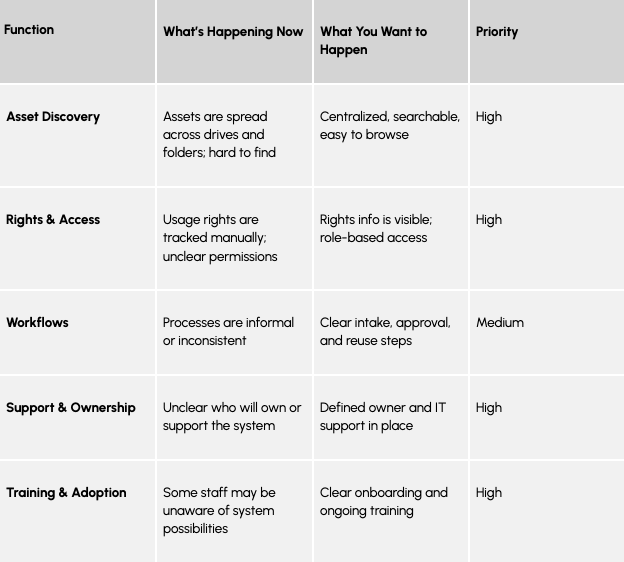
This high-level rubric helps turn qualitative insights into a shared understanding of your current landscape. It can surface high-impact gaps, clarify priorities, and serve as a foundation for your implementation roadmap or RFP.
Keep Listening, Keep Refining
At the heart of a successful DAM assessment are people—the users, decision-makers, and behind-the-scenes teams who rely on digital assets every day. Their insights are the source of your best ideas.
Information gathering isn’t a one-time process. Keep asking questions. Keep listening. As your understanding deepens, your priorities will evolve, and your system requirements will sharpen. The more inclusive and user-driven your approach, the more likely you are to select a DAM that meets your real needs and earns long-term support.
What may feel like a jumble of tools, frustrations, and hopes now will eventually turn into clear priorities, confident decisions, and, most importantly, a system that fits the way your organization actually works.
Focus the Vision for Your Digital Assets
With input from your stakeholders in hand, it’s time to define a shared vision for what the DAM is meant to accomplish. That vision comes to life through clear, outcome-driven business objectives. These objectives articulate the why behind the DAM: why it matters, what it will change, and how you’ll know it’s working.
Business objectives help you prioritize features, align teams, and communicate the system’s value to leadership. They keep the project focused, especially when you’re evaluating trade-offs or making decisions down the line.
Before diving into detailed requirements, ask: What does success look like with a digital asset management system in place? Are you aiming to reduce legal risk? Speed up campaign delivery? Preserve institutional knowledge? These goals shape every step of your selection and implementation process and are communicated through business objectives.
A strong business objective answers:
“What are we trying to improve, fix, or enable with this system?”
Sample Business Objectives:
- Reduce time spent searching for assets by 50% to support faster content delivery Teams currently spend significant time locating approved visuals and files. Reducing this friction will help meet tight publishing timelines and improve responsiveness.
- Ensure only licensed assets are used in public materials Inconsistent tracking of usage rights increases legal and reputational risk. A DAM should help enforce compliance and make rights information visible and actionable.
- Consolidate digital assets created by different users and stored in disparate systems Assets are currently spread across local drives, cloud folders, and legacy tools. Centralizing them will support discoverability, collaboration, and long-term access.
Whenever possible, tie business objectives to measurable outcomes. For example: “Reduce asset search time by 50%” or “Ensure 100% of publicly used assets have visible rights metadata.” These goals can help you evaluate vendors—and later, your DAM’s performance.
Is a New Digital Asset Management System Actually Needed?
One of the goals of a good assessment is clarity. Sometimes that clarity reveals that a new DAM isn’t the right next step. You might discover that your existing system could work with better training, governance, or configuration. Or you may find that the real issue isn’t the technology, but the lack of shared standards or ownership. That’s still progress. A thoughtful assessment can help you solve the right problems, whether or not that includes replacing your DAM.
Next Steps: From Insight to Action
Whether your assessment points to the need for a new DAM or uncovers ways to improve the one you already have, the outcome is the same: you now know what you didn’t know before. It’s time to turn that insight into a plan.
Start by organizing what you’ve learned into something clear and shareable. A spreadsheet, a shared doc, or whatever helps your team keep track of it all. Consolidate data and priorities in one place to prepare for internal planning, vendor conversations, or decision-making.
As you move toward system selection or renewal, take a beat to assess your organizational readiness:
- Who will own the DAM long-term?
- Is IT prepared to support infrastructure, integrations, and identity management?
- Do you have staff or governance in place to manage the operation of the system?
A successful digital asset management system depends on more than just features. It also needs committed people, long-term support, and a structure that can grow with your organization. As you talk with stakeholders and gather input, make sure to document what you’re learning—key themes, priorities, pain points, and goals. Documenting these early insights will help shape shared understanding and keep things grounded as you move into planning and decision-making.
